War, Revolt, and Iran’s Unfinished Struggle
War, Revolt, and Iran’s Unfinished Struggle
The protests and repression that preceded the U.S.–Israeli bombing campaign exposed both the fragility of the Iranian governing elite and the organizational weakness of Iranian civil society—dynamics that will continue to shape the country in the months to come.
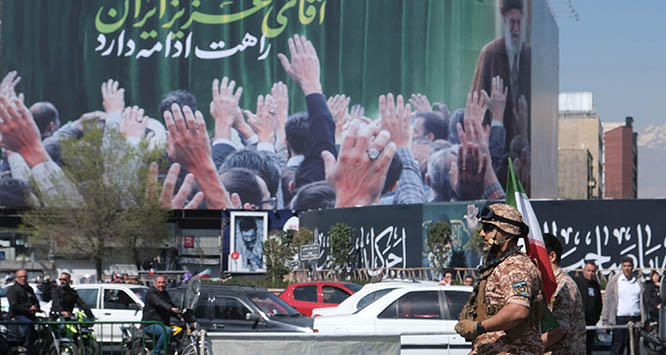
On February 28, after three inconclusive rounds of nuclear talks in Geneva, coordinated U.S. and Israeli strikes targeted senior figures of the Islamic Republic’s political and security leadership as well as key command-and-control infrastructure. In the days prior, Donald Trump had publicly invoked January’s mass killings and the regime’s repression of protesters, framing military action as both a strategic necessity and a historic opportunity. Within hours, state media confirmed what had seemed unthinkable weeks earlier: Ayatollah Ali Khamenei, supreme leader since 1989, was dead. Several high-ranking officials within the security establishment were reportedly killed alongside him. Iranian retaliation followed, including strikes on U.S.-aligned regional states hosting American military facilities. The war, already widening, has become unmistakably regional. No one—not Washington, not Tehran—can predict how it will unfold.
Within the first few days, Trump, Marco Rubio, Pete Hegseth, and J.D. Vance each offered a different war objective—nuclear disarmament, regime change, preemption, and liberation—with no authoritative account of which, if any, would be prioritized. There is good reason to doubt whether the twice-impeached U.S. president who unleashed ICE on Minnesota and the Israeli prime minister living under an ICC arrest warrant are allies of Iranian civil society. Trump has even lamented that early strikes killed Iranians that his administration had earmarked as potential successors, with a candor that reveals his logic more plainly than any official statement. The historical record suggests that for Washington, the operative question has not been what kind of ruler governs a nation-state, but whether they are compliant with, or in defiance of, the American security imagination.
For many Iranians, however, the news produced a conflicted reaction: relief, even joy, that a man long associated with massacre and repression was gone, mixed with fear that war from above would bring devastation of its own, and uncertainty about what would follow.
The crisis surrounding the U.S.–Israeli bombardment threatens to eclipse the crisis that preceded it this winter, when Iran was rocked by massive protests and government repression. This latest cycle exposed both the fragility of the Iranian governing elite and the organizational weakness of Iranian civil society, dynamics that will continue to shape the country’s future.
In late December, the Iranian rial collapsed to an unprecedented 1.42 million to the dollar. Inflation climbed beyond 40 percent. Food and medicine prices surged. Bazaar merchants in Tehran began protesting these economic conditions, and the demonstrations spread rapidly to universities and then to provincial towns like Lordegan, Malekshahi, and Abdanan, long marked by uneven development and state extraction. Within days, demonstrations morphed into the largest mobilization since the 2022 uprising sparked by the death of Mahsa Amini.
On January 8, a crackdown began. Iranian security forces carried out coordinated mass killings across the country. The government has acknowledged at least 3,117 deaths, with independent human rights groups estimating deaths in excess of 7,000. The killings took place during a near-total internet shutdown, in which connectivity collapsed and hospitals were sealed. Families were denied access to bodies, and even mourning was treated as subversion. The repression was systematic and clinical.
The Islamic Revolutionary Guard Corps and affiliated foundations—estimated to control between 30 and 40 percent of Iran’s economy, spanning construction, energy, telecommunications, ports, and black-market trade—remained intact. Scarcity was not evenly distributed. While wages lagged months behind prices and pensioners struggled to secure basic goods, resources continued to flow toward militarized projects and regional interventions. Women’s labor force participation has stood at approximately 14 percent, despite near-universal education. Peripheral regions endured water shortages exacerbated by extractive development and dam projects favoring agribusiness.
When protest emerged from these conditions, it confronted a state whose economic and coercive power were fused. Moral courage faced off against institutionalized coercion, but courage alone did not prevail. The January massacres revealed the asymmetry between diffuse social anger and a centralized security apparatus capable of coordinated violence. Protesters mobilized across class and region—industrial workers, teachers, retirees, precarious service workers, segments of the bazaar economy. Yet in the absence of durable organization, the state retained its monopoly of force. Internet blackouts were not incidental; they were instruments of repression. By isolating cities from one another, the regime ensured that its terror was experienced locally and invisibly.
Decades earlier, in his book Shah of Shahs, journalist Ryszard Kapuściński chronicled the fall of Mohammad Reza Pahlavi, observing how authoritarian regimes often collapse first in belief. Fear ceases to operate; obedience becomes mechanical and legitimacy drains before palaces fall. In 1979, people stopped believing before the state disintegrated. Today, that sequence has been disrupted. Force has struck before belief has cohered into an alternative. The Islamic Republic’s apex has been decapitated by external bombardment before Iranian society has assembled a durable substitute for it.
This situation poses a dilemma: while it would be morally unacceptable to celebrate bombardment, it would be analytically unacceptable to deny that the architecture of coercion has been damaged. Senior command figures are gone, and the chain of authority has been jolted. The balance of forces inside Iran has shifted, though the direction of that shift is undetermined.
The temptation to reduce these events to geopolitics is strong. The regime subsumes revolt and bombardment alike into a language of foreign conspiracy and violated sovereignty. Western leaders speak of the chance to remake the region. Exiled claimants present themselves as inevitable successors. In each case, Iranian society risks becoming reduced to a mere backdrop.
Just as we shouldn’t take Washington’s humanitarian rhetoric at face value and should recognize the forces that have pursued war with Iran for decades, we must also avoid sanitizing the record of the regime whose head has now been struck. The Islamic Republic is not merely a domestic autocracy but a regional project, sustained through decades of transnational violence.
In Syria, Iranian militias helped prop up a government responsible for over 200,000 civilian deaths, in a war that killed more than 580,000 people in total and displaced 13 million. In Yemen, Iran’s backing of the Houthis deepened one of the worst humanitarian crises on earth, leaving over 18 million requiring assistance. In Lebanon, Hezbollah—armed and financed by Tehran at an estimated cost of up to $1 billion annually—imposed its strategic priorities on a state suffering financial collapse. In Iraq, Iran-aligned militias operated as a state-within-a-state, conducting extrajudicial killings and running private prisons. And Iran’s Shahed drones, supplied to Russia, destroyed Ukrainian civilian infrastructure across multiple winters.
The reach of the regime’s repression extended further still—to writers, dissidents, and translators abroad. Most infamous was the 1989 fatwa issued by Ayatollah Ruhollah Khomeini against the Bombay-born writer Salman Rushdie for his novel The Satanic Verses. Rushdie spent years in hiding under police protection, and his Japanese translator was murdered in 1991; in 2022, he was stabbed by an individual widely understood to have been inspired by that decree, leaving him blind in one eye. Thankfully, repression doesn’t always work: Rushdie has written over fifteen books since the fatwa was issued, including two since the 2022 stabbing.
It’s important to insist that the uprisings that preceded this war were not the product of external maneuvering. When women removed their headscarves in 2022 and schoolgirls confronted armed police, their protest was not about an abstraction but embodied defiance of institutionalized misogyny. The disciplining of women’s bodies—through beatings, imprisonment, and documented sexual violence in detention—turned clothing into a referendum on obedience. Ayatollah Khomeini’s Tahrir al-Wasilah established legal frameworks permitting the marriage of girls as young as nine—a doctrine translated into policy after 1979 that has seen tens of thousands of girls between the ages of ten and fourteen married off every year since. Years before hijabs burned in public squares, Azar Nafisi described in Reading Lolita in Tehran how literature functioned for Iran’s women as a fragile refuge against ideological suffocation. By 2022, that search for refuge hardened into overt refusal. The death of Mahsa Amini in morality-police custody transformed this refusal into a mass movement that echoed with the cry of “Woman, Life, Freedom.”
The December 2025–January 2026 uprising extended collective action into the realm of economic life. This was no longer simply a youth revolt or a cultural rebellion but an act of mutiny against a political economy unable to reproduce ordinary existence. The protests were rooted in material exhaustion: wage arrears, collapsing purchasing power, regional dispossession, and gendered exclusion from economic life. When inflation rendered ordinary survival precarious, people went to the streets despite the certainty of repression, fully aware of the risks.
But lacking institutional depth—independent labor organization, strike coordination, and durable networks capable of surviving repression—revolt collided with a still-cohesive core of coercion. Now that core has been struck from above, and the war is redrawing the terrain on which Iranian politics will unfold. Yet if this moment ends as nothing but a contest between states—between declarations of liberation and invocations of sovereignty—Iranian society will disappear again.
Israeli strategists have been explicit that their preference is not smooth regime change but state collapse and even regional destabilization. Washington’s objectives, on the other hand, remain deliberately incoherent, but are likely part of a pressure campaign against Beijing (as was the case in Venezuela), aimed at denying it access to Iranian oil and a crucial regional ally.
Yet focusing only on foreign war aims risks obscuring the fate of people living in Iran and their capacity to act. In parts of the international left, opposition to U.S. power has hardened into a strategic rather than universal morality, in which regimes that position themselves against Western hegemony are granted contextual indulgence and afforded a different, lighter register of judgment than institutionalized democracies. Herbert Marcuse once theorized a form of “liberating tolerance” that justified asymmetry in the service of emancipation; in practice, such asymmetry often slides into geopolitical campism. Today, we need to consider not just who delivered the blow to the Islamic Republic, but whether Iranian society can act within the chaos that blow has created.
For nearly four decades, Khamenei functioned as the Islamic Republic’s spinal cord—mediating factional rivalries, arbitrating elite disputes, and preventing the rise of serious internal challengers. But the regime’s durability did not rest on his charisma alone. It fused clerical authority with bureaucratic depth and militarized enforcement. The constitutional mechanism for succession remains formally intact: the Assembly of Experts—itself recently targeted by airstrikes—is charged with selecting the next supreme leader. In practice, however, that selection has always been shaped by elite bargaining, preemptive consensus-building, and the shadow weight of the Revolutionary Guard.
Three structural realities now complicate the transition. First, there is no publicly acknowledged successor. Second, no senior cleric commands an independent religious gravitas combined with broad social legitimacy. Third, the security establishment—already embedded within the economy and political apparatus—is likely to play a decisive role in managing the outcome.
Under conditions of war, the temptation toward consolidation is strong. Emergency rhetoric licenses extraordinary measures. A weakened regime may attempt to reassemble cohesion by tightening control, purging unreliable elements, and presenting unity as survival. The same apparatus that executed coordinated killings in January has been jolted, not dissolved. This is the first illusion to resist: that decapitation will equal democratization.
A second illusion moves in the opposite direction: that nothing has changed. That, too, is untenable. The removal of a supreme leader who monopolized ultimate authority inevitably creates instability. Political succession under bombardment is not choreographed continuity, but improvisation under pressure. In such moments, projects designed to contain society tend to multiply. “Managed transition,” reshuffled elites, symbolic concessions without structural change—these are familiar strategies in authoritarian crisis.
Abroad, fantasies of monarchist restoration have resurfaced with predictable speed. Yet credibility in democratic politics rests not on nostalgia but on accountability. As the U.S.–Israeli bombardment kills Iranian civilians, royalist voices reduce the dead to abstract “casualties,” even as their public condolences are directed primarily toward Western soldiers targeted in the subsequent escalation. Such asymmetry does not inspire confidence in a democratic future. Authority cannot be improvised on social media, nor built on reactive indignation. Nor can it be delivered from abroad. No airstrike constructs labor unions, builds councils, or creates independent media. No foreign power can manufacture the dense networks of trust required for durable democratic life.
The fragmentation of the exiled opposition illustrates the deeper problem. Reza Pahlavi has urged Iranians to take to the streets, though how they would do that under actual bombardment is anyone’s guess. The MEK—reviled by many Iranians for having fought on Iraq’s side against Iran in the 1980s—has announced a provisional government from Paris. Trump has been tepid about Pahlavi, suggesting he would prefer someone inside the country, perhaps planning to replay Venezuela, where he removed Nicolás Maduro while allowed Delcy Rodríguez—Maduro’s vice president and a lifelong Chavista—to be installed as acting president. Meanwhile, five Iranian Kurdish parties have united under a coalition, with fighters already moving toward the border—though Iranian Kurds lack the influence or resources to sustain a successful uprising alone. Regime change cannot be effected from abroad, and the Venezuelan precedent suggests it may not even be tried.
After all, this was the central lesson of January. Revolt without institutional depth collided with centralized coercion. The war may alter that terrain and disrupt command hierarchies, puncturing the regime’s aura of invulnerability. Disruption, however, is not organization: a fracture at the top does not automatically translate into capacity at the bottom.
Iran now stands at a threshold. The regime may further consolidate under emergency logic. It may fracture under elite rivalry. Or it may alter its face while preserving its structure. But crucially, what it cannot easily restore is the aura of inevitability.
In the absence of durable opposition institutions, culture matters—not as ornament, but as evidence of endurance. Refusal has deep roots. So does the insistence on speaking up in defiance of restrictions. The director Jafar Panahi, prohibited by the regime from filmmaking for twenty years, smuggled his 2011 film This Is Not a Film out of Iran on a USB drive concealed inside a cake. Under such conditions, making a film became an act of persistence rather than proclamation. Art may not dismantle the security apparatus. But it preserves the capacity to refuse its moral claims. Sometimes that refusal even outlives the power that tried to silence it.
In the fourteenth century, the Persian poet Hafez wrote:
واعظان کاین جلوه در محراب و منبر میکنند
چون به خلوت میروند آن کار دیگر میکنندThose preachers who make such a show in pulpit and prayer-niche
When they retreat in private, do quite another thing.
We should keep such verses in mind in moments when every side proclaims righteousness—in the language of security, liberation, sovereignty, or salvation. War may redraw the field. Leaders may fall. But the deeper struggle is over who names reality, and whether society can build forms capable of carrying that reality through ordinary time—not only in this rupture, whose consequences remain dark and unmeasured, but through the long aftermath that no airstrike can shape. If that struggle endures—in the streets, in unions yet to be built, in films made under a ban, and in verses remembered under curfew—then the rupture opened by Khamenei’s death need not become repetition.
Sahasranshu Dash is a research associate at the International Centre for Applied Ethics and Public Affairs (ICAEPA), an independent research organization based in Sheffield, UK.
Siyavash Shahabi is an Iranian journalist and activist living in exile. He is a member of Iran Labour Confederation – Abroad, which through direct contact with different layers of Iran’s labor movement works to build bridges with international bodies and trade unions in other countries.