Vindictive Federalism
Vindictive Federalism
For decades, national policies have compelled states to pare back eligibility and benefits for social programs. Under Trump, federal austerity has become a tool to punish political enemies.
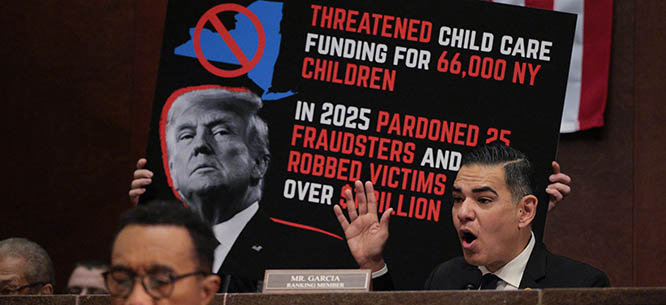
In January the Trump administration informed five states—Minnesota, New York, California, Illinois, and Colorado—that it was freezing more than $10 billion in social service and child-care funding, citing “credible concerns about fraud and misuse.” The freeze was accompanied by a request for states to supply “the complete universe” of documents relating to program eligibility and benefits within two weeks. The data demand was both utterly unrealistic and an apparent “fishing expedition to find a post hoc rationalization for the Freeze itself,” according to a lawsuit filed by the five states against the federal government.
Even for this administration, the freeze was, in the words of the Center for Law and Social Policy, startlingly “illegal, reckless, and cruel.” It made poor children and families collateral damage in a political standoff. It threatened not just a loss of federal funds, but devastating economic consequences as families lost child care and employers lost workers.
The targeted states immediately challenged the freeze on the grounds that each of the programs at risk had elaborate compliance rules and procedures in place; that the freeze steamrolled congressional authority over spending; that the administration was, by its own admission, motivated by a desire to punish “Democrat-led” states; and that its “serious concerns” were little more than wildly speculative allegations. It took the courts less than a day to issue a restraining order blocking the freeze.
The episode is a telling one. It shows the administration’s embrace of the idea that federal social spending is overwhelmingly (and fraudulently) claimed by undeserving able-bodied adults. And it underscores its conviction that immigration, especially from the administration’s growing roster of “shithole” countries, is—as Homeland Security Secretary Kristi Noem recently put it—“flooding our nation with killers, leeches, and entitlement junkies.”
More broadly, the move to freeze funding demonstrated the administration’s disdain for political norms and institutions. A gleeful expansion of executive authority has trampled on the judiciary, congressional prerogatives, and the independence of independent agencies. It has also flouted jurisdictional lines between national, state, and local power. In this respect, the funding freeze echoes other efforts—recently on stark display in Minneapolis—to target states and cities governed by Democrats.
As federal institutions face the threat of an imperial presidency, states and cities face a new regime of vindictive federalism. The stakes are especially high for social policy. A generation of welfare “reform” already led to the abandonment of federal standards and commitments, leaving the task of social protection largely in state hands. The funding freeze raises the prospect that devolution will be compounded by retribution; that what’s left of social citizenship can be suspended on petty or partisan whims.
American federalism is a peculiar beast. The Constitution enumerates limited federal powers—mostly involving international or interstate issues—and delegates everything else to the states. The framers, and many since, have lauded this arrangement as a guarantor of political accountability, efficiency, innovation, and liberty. By such reasoning, federalism checked the potential tyranny of federal power, pushed political responsibility to smaller political units responsive to local needs and aspirations, and encouraged political innovation across these subnational laboratories of democracy.
But it hasn’t really played out this way. States boast starkly different political aspirations, fiscal capacities, and commitments to equal protection. Through the 1960s, the principal function of federalism was to provide justification for slavery and Jim Crow. Since the 1960s, political polarization and policy devolution have made state capitols a playground for conservative policies. In practice, federalism fragments social protection and undermines any pretense of social citizenship; it is itself a powerful source of inequality.
In social policy, federalism’s shortcomings and perils have emerged in stages. Through the 1930s, a system of “dual federalism” saw state and federal jurisdictions tending their distinct constitutional rows. Social assistance was confined to scattered local and private efforts and was especially meager where it threatened deeply racialized state and local labor markets. With few exceptions, the courts slapped down federal efforts to offer more expansive social protections and labor standards.
As the Great Depression overwhelmed state and local relief, New Deal policies launched an era of “cooperative federalism,” marked by shared financing of key social programs for poor families and the unemployed. While the federal treasury footed much of the bill, Southern legislators were able to exempt agricultural and domestic workers from coverage and retain state control over eligibility and benefits. The result, as the NAACP’s Charles Houston noted at the time, was a social policy “sieve with the holes just big enough for the majority of Negroes to fall through.”
State cooperation was often reluctant, and state governments—especially in the South—came to see federal grants as more stick than carrot. Cooperative federalism, in this respect, could also be coercive; instead of helping states meet policy goals with more federal dollars, it could compel them to do so, by threatening to withdraw support.
One notable example of the new coercive federalism occurred in 1984, when the Reagan administration pushed states to raise their drinking age to twenty-one under threat of diminished highway funding. The Supreme Court rebuffed state challenges, arguing in South Dakota v. Dole (1987) that the federal government could set any reasonable condition on federal highway grants and that the proposed penalty was “not so coercive as to pass the point at which pressure turns into compulsion.”
For the most part, such coercion was employed to encourage or cajole states into participating in federal programs or forcing them to meet federal standards. This created something of a floor for national social policy: fiscal incentives drew all states into federal programs for cash assistance and unemployment insurance, while federal thresholds (as with the minimum wage) served as a foundation for divergent state policies.
In social policy, unfortunately, that floor soon became a ceiling. Beginning in the 1970s, federal policy encouraged and increasingly required states to constrain eligibility for Aid to Families With Dependent Children (AFDC) with an array of work and behavioral requirements. “Getting tough” on welfare dovetailed with mass incarceration in an ever more integrated system of neoliberal social control. States floated new restrictions on the eligibility of immigrants.
All of this was codified by the Personal Responsibility and Work Opportunity Reconciliation Act (PRWORA) of 1996, which “ended welfare as we know it” by replacing a means-tested entitlement to cash assistance with a conditional and time-limited benefit. PRWORA simultaneously unleashed the states and corralled them. The new Temporary Aid for Needy Families (TANF) program reconfigured the federal contribution as a stagnant block grant and broadened state discretion, especially with respect to spending.
But just as important, TANF effectively capped any lingering state generosity, forcing all states to adopt the standards and conditions set by the bottom-feeders before 1996. Its terms were not just coercive but increasingly punitive: sanctioning recipients who failed to meet the program’s new work and behavioral requirements, and sanctioning states that failed to meet the “welfare to work” targets of the federal program. Federal coercion was startlingly effective. In 1995, AFDC reached eight in ten poor families; by 2023, TANF rendered cash assistance to just two in ten.
Animated by TANF’s invocation of shiftless dependency, work requirements spilled into other arenas of social policy. PRWORA also set work requirements for the Supplemental Nutrition Assistance Program, which were significantly expanded last year. The first Trump administration, for its part, leaned into this fascination with “workfare” and encouraged states to experiment with work requirements for Medicaid. Last July, it made such requirements national policy.
In turn, federalism’s inequality machine has been fueled by political polarization. In 2012, when the Affordable Care Act tried to leverage Medicaid expansion in the states, the Supreme Court (in National Federation of Independent Business v. Sebelius) ruled for the first time that the terms of a federal grant were unduly coercive. The threat of reduced funding for states declining to expand Medicaid was, the court concluded, a form of “economic dragooning that leaves the States with no real option but to acquiesce.”
The initial Medicaid expansion decisions fell cleanly along partisan lines: of the twenty-six states declining to expand Medicaid in 2014, Republicans claimed trifecta control in nineteen. Since 2014, legislation and ballot measures have whittled the number of ACA holdouts to ten states. Republicans control both statehouses in all of these, and claim trifecta control in eight of them.
Partisan posturing and social policy foot-dragging were also evident during the pandemic. States invented their own idiosyncratic metrics for reopening schools or state economies, and opted out of pandemic unemployment programs along predictably partisan lines. The first Trump administration did not hesitate to politicize the federal pandemic response, favoring red states and penalizing blue states at every opportunity. Federal policy was, as Michigan’s Democratic Governor Gretchen Whitmer noted acidly in the pandemic’s early weeks, a “patchwork, based on who . . . the governor is.”
The era of punitive and polarized, even vindictive, federalism returned with Trump’s reelection in 2024. Open disdain for Democratic states and cities, coupled with the administration’s simmering thirst for political vengeance, drove the persistent use of fiscal and physical threats to bring opponents to heel.
Since his return, Trump has withheld federal grants from universities and public health organizations, taken aim at law firms and liberal foundations, and used the fall shutdown as a pretext to slash disaster aid and energy projects in blue states. He recently renewed plans to withhold federal funds from states with “sanctuary cities,” despite a district court’s admonition that such “coercive threats” were blatantly unconstitutional. Waves of hostile urban incursions by ICE and National Guard units have been justified by the administration’s determination to crack down on “places that are run by Liberal Democrats.”
For the nation’s first 250 years, the Madisonian conviction that federalism was a bulwark against tyranny seemed at best quaint and at worst disingenuous. The Constitution’s deference to the states, after all, supported a century of slavery and then a century of Jim Crow. Federal social policy from the New Deal to the Great Society was, in large part, a struggle to overcome local tyrannies.
The new federalism of the 1970s, followed by the welfare “reforms” of the 1980s and 1990s, flipped that logic: national policies now compelled states to pare back eligibility and benefits. If federalism tipped from “cooperative” to “coercive” in the 1970s, it has now tumbled—in short order—from coercive to nakedly punitive and vindictive.
This marks a difference both in degree and in kind. Trump’s social policies double down on an older austerity federalism, effectively diminishing the capacity of blue-leaning states to deliver social goods or social protection. But they also infuse that austerity with the retributive logic of our polarized politics. Trump’s social policies, exemplified by the funding freeze, target states and cities less for their failure to meet national priorities or standards than for their votes in the last election. The federal carrot, at least for Democrat-led jurisdictions, is now all stick.
Colin Gordon is a professor of history at the University of Iowa and the author, most recently, of Patchwork Apartheid: Private Restriction, Racial Segregation, and Urban Inequality.