The Trump Doctrine
The Trump Doctrine
For years, Venezuelans have been trapped between two rogue states, with many reduced to hoping that one could solve the problem of the other. But it is the Venezuelan people who should decide how Venezuela is governed, and by whom.
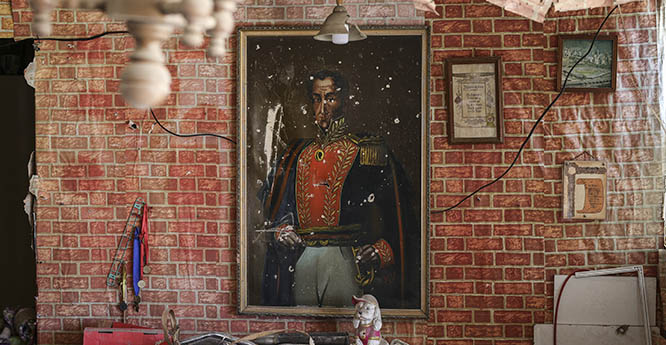
For months, the Trump administration has been engaged in a series of escalatory strikes on Venezuelan targets. It incinerated small boats in the Caribbean and eastern Pacific, which it claimed, without presenting evidence, were involved in drug smuggling. In at least one case, it murdered shipwrecked survivors. It seized two oil tankers and trailed another. It declared that Nicolás Maduro was the head of a narco-government, which “stole” Venezuela’s oil from U.S. companies. Then, in the early hours of January 3, special operations forces seized Maduro and his wife, Cilia Flores. They have been brought to the United States to stand trial. The day of their capture, Trump announced, “We are going to run the country.”
The core commitment should be this: it is the Venezuelan people who should decide how Venezuela is governed, and by whom. The Trump administration has demonstrated little interest in that outcome. Its actions have broken national and international laws. For Trump, that may be part of the point—the swaggering bravado of it all. Trump’s promise to his followers has always been that he will break decorum, even laws, to do what he thinks should be done. Who will stop him? Thus far, no one has.
In Maduro, Trump had a soft target. Maduro is loathed by most Venezuelans. He is, of course, detested by Latin America’s political right and center. In a poll published in early November, 53 percent of people across Latin America supported a U.S. military intervention to depose Maduro. He is even viewed as a burden by most on the region’s left, some of whom will have been quietly relieved to let the United States do the dirty work of removing him. When the news broke on Saturday, I was in Santiago, Chile. A large Venezuelan diaspora resides here, and the morning was full of celebration. Down the city’s main avenue, people honked horns. They gathered in cafes to cheer Maduro’s downfall, as Venezuelans did elsewhere in the many places where his rule disrupted lives and sundered families. (Roughly 8 million Venezuelans—about a fourth of the population of the country—have emigrated in recent years.) He stole the elections in 2024 through brazen fraud and has repressed and intimidated the opposition.
The celebrations may not last for long. Maduro and Trump share the same stance on elections: they are to be recognized if and only if they produce the result that the leader desires. Trump seems to think he will be able to rule by threat and by proxy.
It is not democracy promotion that motivates Trump, but Maduro’s removal does serve a number of other purposes. A stable Venezuela would produce fewer migrants and be easier to deport people to, pleasing white supremacists like Stephen Miller. Marco Rubio, with his power base in South Florida, has a deep ideological commitment to toppling the nominally socialist but indisputably authoritarian governments in Venezuela, Nicaragua, and, especially, Cuba. Trump, on the other hand, campaigned against “nation-building.” But someone convinced him that Venezuela had stolen U.S. oil, and he relishes the opportunity for a display of dominance. “We are not afraid of boots on the ground,” Trump said after the operation, but he does not seem to be planning a full-scale invasion. Roughly 15,000 troops have been deployed in the naval buildup in the region, far fewer than what would be needed to occupy a country that is only a bit smaller than Afghanistan and Iraq combined.
Within Venezuela itself, the mood after Maduro’s removal was much more guarded. In Caracas, people didn’t spill out into the streets to celebrate, or to protest. Many tried to buy food and shelter in place, wary of physical danger from further U.S. aggression, regime retaliation, a breakdown in civil order, or some combination of the three. Vice President Delcy Rodríguez went on the air, vowing to resist and calling Maduro the only legitimate president of Venezuela. But that may have been a display for party loyalists. Trump thinks it was. At a press conference, he said that Rodríguez “had a long conversation with Marco. . . . I think she was quite gracious, but she really doesn’t have a choice.” Anonymously, one Trump administration official said “she’s certainly someone we think we can work at a much more professional level than we were able to do with [Maduro].” She has oscillated between conciliatory and confrontational statements.
Some have speculated that Maduro may have been given up by high officials in an effort to sacrifice a poor leader in order save the regime. If so, it is hard to square with the level of destruction to military targets during the attack, or the risk of internal fracture if evidence of a plot were to be revealed. But one bargaining chip that could have been offered to the Trump administration is the country’s relationship with Cuba, which assists Venezuelan state security in exchange for oil. (The Cuban government says thirty-two of its citizens were killed in the attack, a large portion of the roughly eighty people total who were killed.) Maduro was deeply committed to Venezuela’s special relationship with Cuba, which was of huge symbolic importance to his much more charismatic predecessor, Hugo Chávez. There is speculation that this is not an enthusiasm shared by Rodríguez. Rubio may have his eye on what would be, for him, the greatest prize of all.
The Venezuelan opposition, meanwhile, seems to have been sidelined. Trump casually dismissed working with María Corina Machado, the recent Nobel Peace Prize winner, saying, “She’s a very nice woman, but she doesn’t have the respect.” This is backward: she isn’t particularly nice, but, barred from running, it was “her” candidate, Edmundo González, who rightfully won the elections in 2024. Machado does notably lack support from two key groups: the Venezuelan military and Trump himself, who is irked that she got the Nobel Prize that he delusionally believes he deserves. Machado won’t be the first to find out that attempting to influence Trump—including, in her case, misrepresenting Maduro’s role in drug trafficking—may not get her what she wants. But if the opposition is to be discarded, then either a reconsolidation of the current regime in some new form or some kind of imperial mandate (or a combination of the two) seem to be what is on offer. It may still be a long time before Venezuelans get to decide how the country is governed.
If the sequence of events has been shocking, it is, at the same time, unsurprising. As Derek Guy joked on social media, “we’re living through precedented times.” The history of U.S. intervention in Latin America is long and unhappy. Trump has chosen to act as a cartoon version of the U.S. imperialist, drooling about oil even as U.S. energy companies seem hesitant to get involved, given the difficulties of rebuilding deteriorated infrastructure and refining Venezuela’s heavy sulfuric crude at current prices. At a press conference, Trump even managed to mumble something about the “Donroe Doctrine.”
The original Monroe Doctrine, declared in 1823 during the process of Spanish-American independence, insisted that the Western Hemisphere should be closed to European colonization. At the time, it was not entirely unwelcome—though Simón Bolívar famously foreshadowed that “the United States appear to be destined by Providence to plague America with misery in the name of liberty.” The Roosevelt Corollary to the Monroe Doctrine, issued approximately eighty years later by Theodore Roosevelt, promised that the United States would act as a police power in the hemisphere. The next decades were full of long occupations of countries in and around the Caribbean, none of which produced long-term stability or prosperity. During the Cold War, the United States launched more covert interventions against governments that it did not favor, while supporting right-wing dictatorships that killed and tortured thousands.
During the Obama presidency, Secretary of State John Kerry stated that the “era of the Monroe Doctrine is over,” indicating an end to that kind of heavy-handed interference, and promising greater cooperation and respect. In recent years, China has become the largest trading partner to many countries in South America. U.S. dominance is not what it once was, and strategic nonalignment with either China or the United States has been a sensible posture for governments in the region.
Trump, who is more interested in coercion than cooperation, views the abandonment of the Monroe Doctrine as a mistake. In a National Security Strategy document released in November 2025, the administration posited a “Trump Corollary” to the doctrine, promising greater interventionism than ever. “To restore American preeminence in the Western Hemisphere,” the document says, the U.S. government “will deny non-Hemispheric competitors the ability to position forces or other threatening capabilities, or to own or control strategically vital assets [my italics], in our Hemisphere.” This was the logic of the Trump administration’s pressure on Panama early in his second term.
The Trump administration’s legal justification for the kidnapping of Maduro, without congressional authorization or a declaration of war, was that it was serving a warrant for criminal arrest, and that the military action was required to support that civil action. As legal historian Oona Hathaway pointed out, if involvement in drug smuggling is sufficient justification for foreign intervention, then the international system of state sovereignty is effectively a dead letter. Trump is asserting a dangerous new reality, in which his determination to bomb targets, conduct raids, and destabilize governments requires neither consent, nor cooperation, nor approval. After the Venezuelan operation, Stephen Miller’s wife posted an image of Greenland draped in red, white, and blue, capped with the word “SOON.”
Disapproval has begun to pour in from around the world: not in defense of Maduro, but in defense of the broader principles that imperfectly govern international relations and protect smaller states from the predations of larger ones. Mexico’s President Claudia Sheinbaum filed a complaint in the United Nations, arguing that Trump has violated Article 2, which states that members of the UN “shall refrain . . . from the threat or use of force against the territorial integrity or political independence of any State.” The echoes of past imperialism are loud. “We Latin Americans cannot accept that we exist only in function of the economic or political interests of another country,” wrote the editorial board of the Central American newspaper El Faro. “We should never again allow a return to the days when our lives were decided in Washington without even taking us into account. Never again should we allow them to take away our right to self-determination.”
Trump won’t care. He doesn’t know why international organizations exist. He may relish the idea of a world order in which the strong do what they may. Nor is he worried about the moral, economic, and political costs of imposing unpopular client states on foreign populations in the name of U.S. national security.
Trump’s strategy for Venezuela appears to be to use threats of further violence and economic coercion to ensure compliance with the United States. That is unlikely to be sustainable for whoever leads Venezuela. The current regime relies on patronage networks that could easily fall apart under those conditions. Even now, the Venezuelan state does not possess a monopoly on the legitimate use of violence throughout the country’s territory. Internal violence and further instability seem far more likely than not. As usual, removing the nasty leader is the easy part. There are more ways for what follows to go badly than for it go well.
It is a sad fact that Venezuelans have, for years, been trapped between two rogue states, with many reduced to hoping that one could solve the problem of the other. Those of us who do not believe that the United States should play an imperial role in Latin America or elsewhere must face that we had no answer for a criminal apparatus that took over a country. But that doesn’t mean that we have to accept a United States determined to govern the hemisphere with its own interests in mind. The abuses to follow will be too many to count. It is, remember, the Venezuelan people who should decide how Venezuela is governed, and by whom. Not the United States. Not a dictatorship. And certainly not some chimera of the two.
Patrick Iber is co-editor of Dissent.