
The Epstein Class
The Epstein Class
The real scandal of the Epstein saga is not that a billionaire cabal runs the world. It’s that there is a billionaire class.
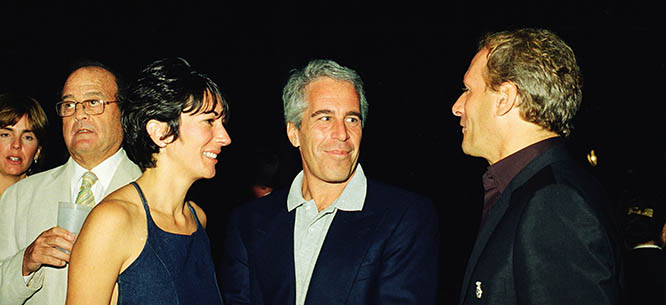
Jeffrey Epstein checks every conspiracist box. The late sex trafficker was a Jewish financier linked to the Rothschilds, the Rockefellers, the Trilateral Commission, and the Council on Foreign Relations. His influence extended to the House of Saud, the House of Windsor, the Russian Federation, and Israel. He liked pizza. Renewed attention to the astonishing number of prominent men cultivated by Epstein has poured fuel on simmering conspiracy theories of shadowy child trafficking rings run by powerful elites. As Ana Marie Cox observed in the New Republic, “every new file drop brings at least a whisper of validation to QAnon’s core contentions.” Even some serious-minded observers are willing to entertain increasingly outlandish claims. Tara Palmeri, one of the most prominent journalists on the Epstein beat, even suggested that Epstein might have been growing mind-control plants in his garden to turn his victims into zombies.
As a result, in February former Secretary of State Hillary Clinton found herself fielding questions about Pizzagate and UFOs when she testified before Congress about her nonexistent relationship with Epstein. Beginning in the 2016 presidential election, peddlers of the Pizzagate conspiracy theory, which laid the groundwork for QAnon, held that Clinton and other high-ranking Democrats were trafficking children from the basement of a beloved family restaurant in Washington, D.C. that has no basement. Internet sleuths convinced themselves that references to pizza in campaign manager John Podesta’s leaked emails were a pedophile code. “I think that this is all very reasonable,” said Representative Lauren Boebert after asking Clinton whether any of the codewords from Pizzagate surfaced in the Epstein files. “I mean, I expected a lot of interesting questions today, but Pizzagate was not on my list,” the former secretary replied. “That’s okay. We’re asking all sorts of things here,” Boebert answered cheerfully. “You certainly are,” Clinton sighed. “You certainly are.”
The Epstein records released by the Department of Justice have exposed a world of unimaginable privilege and sparked a global backlash against what has come to be known as the Epstein Class. QAnon was a right-wing movement, but Epstein conspiracism has now gone fully bipartisan. Presented with a once-in-a-lifetime opportunity to hold the powerful to account, we are teetering on the edge of lunacy. Yet the real scandal of the Epstein saga is not that a billionaire cabal runs the world. It’s that there is a billionaire class. The moral of the Epstein files is that nobody should be that rich.
It is notable that all the arrests sparked by the release of Epstein-related documents so far have been for public corruption, rather than sexual abuse. In the UK, the files precipitated the first arrest of a senior member of the royal family in nearly four hundred years. The country’s self-proclaimed Prince of Darkness, former senior Labour cabinet minister Peter Mandelson, has also been arrested and investigated by the Metropolitan Police for allegedly leaking state secrets to his close friend; in 2009, he reportedly colluded with Epstein to undermine his own government’s policy on taxing bankers’ bonuses. In Norway, former Prime Minister Thorbjørn Jagland was stripped of his diplomatic immunity by the Council of Europe and charged by police with gross corruption after the files revealed him to be a member of Epstein’s inner circle who allegedly accepted travel and other goodies while he chaired the Norwegian Nobel Committee and the Council of Europe in the 2010s.
Despite these revelations, the over 3 million additional pages of files released to date have failed to establish that Epstein was running a QAnon-style child sex trafficking ring that served up minors to large swathes of the global elite. Epstein created a pyramid scheme to procure underage victims at scale. He paid his victims hundreds of dollars to recruit their friends. The younger the better, he liked to say. Yet for the most part, Epstein recruited his underage victims to feed his own raging sex addiction. His former assistant told the FBI that she scheduled up to three sexualized massages for him each day. She said she made hundreds of massage appointments for Epstein, including encounters with dozens of minors. One victim stated that Epstein needed to have three orgasms daily in order to function. “It was biological, like eating,” she said. As astonishing as it sounds, Epstein was trafficking primarily to himself.
Trial lawyer Brad Edwards has represented over 200 Epstein victims and won millions of dollars to help them rebuild their lives. He knows the case as well as anyone alive. He has worked closely with the Department of Justice. Edwards even served as a confidential informant in an FBI sting to recover Epstein’s black book from a household employee trying to sell it. He has no incentive to downplay Epstein’s crimes. On the contrary, it’s in Edwards’s interest to identify as many abusers as possible so that he can seek justice for victims. Yet the newly released files support the picture Edwards originally laid out in his 2020 book, Relentless Pursuit:
The primary, if not exclusive, purpose of the operation was Epstein’s personal sexual gratification. If some of his friends liked what they saw and wanted to partake, Epstein would share with a select few. For those who participated, it incidentally provided ammunition for Epstein to hold over their heads if he ever wanted to, but despite all the speculation, there has been no recovered evidence that he actually used any of this sexual information against anyone in order to get something out of them.
Indeed, of the Epstein victims interviewed by federal prosecutors in the Southern District of New York in their search for potential co-conspirators, only one—the late Virginia Roberts Giuffre—alleged that she was ordered to service other men as a minor. Investigators were unable to corroborate these claims. Two other victims told the prosecutors that they were occasionally asked to massage a few of Epstein’s closest friends, but denied being directed to have sex with them. Both described being surprised when some men demanded sexual favors during what they expected to be non-sexual massages. Both were of legal age at the time.
The DOJ recently released previously withheld FBI interviews with another victim. She claimed that, circa 1983, Epstein transported her from South Carolina to New York (or maybe New Jersey) to be abused by Donald Trump. However, journalists have not been able to corroborate her claims. Moreover, there is no evidence that Epstein and Trump were friends in the early 1980s; reportedly, the two became friends in the late eighties and close in the early nineties after Epstein moved to Florida. A woman referred to as Jane Doe #4, whose accusations match the FBI interviews, received a settlement from the Epstein estate, but only after she was turned down by the Epstein victim’s compensation fund, which assigned an independent claims administrator to assess claims on their merits.
The files, moreover, offer no evidence that Epstein was blackmailing his friends as a business model. On the contrary, he seemed to be on great terms with his inner circle: year after year, Epstein’s friends clamored to hang out with him.
As the notorious 2003 birthday album demonstrates, Epstein’s friends knew he was a pervert, whether they realized he was preying on underage girls or not. In 2008, Epstein pled guilty to soliciting prostitution from a minor. From then on, it was a matter of public record that Epstein was a convicted felon who had served jail time for sex crimes against minors. His friends couldn’t have cared less.
By paying the girls, Epstein created disposable victims in the eyes of his peers. He painted himself as the victim of overzealous prosecutors and feminists who wanted to interfere with a man’s right to enjoy “rub and tug” massages in the privacy of his own home. “The view among Epstein’s wide circle of loyal, devoted, and largely unquestioning friends was that Epstein was guilty only of venial sins,” wrote Epstein’s would-be biographer Michael Wolff. To Wolff, Epstein was just “an insistent playboy (excuse me, pedophile) in a correct and prudish world.”
“I mean, he was with a 17-year-old prostitute, got prosecuted for it and got put away for a year,” onetime friend and client Leon Black—co-founder of the private equity firm Apollo Global Management, and once the king of the junk bond dealers—told a Puck reporter. “I didn’t think this was the end of the world, frankly.”
“I’m betting that for a lot of these girls the best thing they did in their day was to visit Jeffrey—compared to what they were doing in their miserable lives,” Epstein’s lawyer Reid Weingarten told Wolff, “but you can’t actually say that.”
Epstein was worth over $600 million when he died in 2019. How did a college dropout from Coney Island amass such a fortune? The source of his wealth has been hotly debated, but it’s not actually that mysterious. Many people who ask that question don’t really want to hear the answer: to them, it’s axiomatic that the money must have come from thinly veiled blackmail payments or fees for child rape.
There is no evidence that Epstein made his fortune by trafficking girls to other men. He wasn’t a pimp. There is no “client list” because Epstein didn’t have those kinds of clients. Most victims allege abuse only by Epstein and his female accomplices. Those who report sexual contact with Epstein’s friends tend to describe it as a rare occurrence, and not something they were specifically directed or paid to do. Giuffre is the notable exception. There are still 2.5 million unreleased Epstein files. Perhaps more evidence will ultimately come to light, but for now we’re left with copious evidence of Epstein trafficking to himself and no hard evidence that he trafficked to others as a business.
Nor is there evidence that Epstein’s primary business model was blackmail. If Epstein were blackmailing his benefactors, why did he let the two biggest contributors to his net worth stop paying him and walk away without any public sign of retaliation? It would also have been extremely short-sighted for Epstein to blackmail victims for crimes that he was directly implicated in. Epstein was an abuser and a conman who coerced people however he could. He once insinuated that he’d expose Microsoft founder Bill Gates’s affair with an adult bridge player if Gates didn’t reimburse Epstein for an expense he’d incurred on the player’s behalf. Yet when Gates blew Epstein off, Epstein apparently didn’t expose him. Some have even speculated that Epstein made his money by selling sexual secrets to an intelligence service, but there is no hard evidence of that either.
It’s true that Epstein lacked academic credentials, but he had a serious apprenticeship in finance. He made partner at the storied Bear Stearns investment bank in just five years by advising the firm’s richest clients on the tax implications of their portfolios. Epstein was a phenomenal networker who surrounded himself with luminaries who conferred an aura of legitimacy upon him. He enticed his clients with a mix of real skills and shameless self-promotion. He pursued a clientele that was so rich that his exorbitant fees were trivial to them.
Epstein stole most of his fortune from L Brands founder Leslie Wexner. Much of the rest he earned from Black. By telling everyone he advised Wexner and Black, Epstein attracted other super-rich clients. When Epstein came under criminal investigation for abusing girls, he agreed to step back from Wexner’s finances in 2007. It was then that Wexner’s wife Abigail took on the job and discovered that Epstein had stolen hundreds of millions of dollars, of which he repaid only $100 million. Wexner says he cut Epstein out of his life at that point. Asked in his deposition how much Epstein had stolen from him, Wexner replied, “I don’t know. I don’t think I’ll ever know.” Epstein parked his ill-gotten gains in the heavily tax-sheltered U.S. Virgin Islands, where his fortune could sit and grow through the power of compound interest.
Epstein was a hyper-parasite—a parasite whose quarry is other parasites. He excelled at finding arenas where he could operate with minimal supervision. Family offices were an ideal habitat. These are private companies that curate the lives and fortunes of the ultra-rich. They craft wills and trusts to dodge taxes. They invest the family’s money. They juggle their yachts, jets, and mansions. All their operations are cloaked in secrecy. Epstein’s gigs were low-supervision because the point of a family office is not having to worry about it. The Wexners and Blacks of the world want to outsource their personal lives. These billionaires paid Epstein so they didn’t have to keep track of how many silver teaspoons they had at each manor. Epstein took full advantage of their indifference.
Leon Black’s family office, Elysium, was named for an eternal paradise for those granted immortality by the gods: the ultimate VIP lounge. Black said he was so rich he never bothered to add up what he paid Epstein. In fact, Epstein was paid $158 million over several years. The consulting relationship began when Epstein proposed a solution to a major tax liability that was stumping Black’s lawyers and financial planners. Outside attorneys confirmed that Epstein’s solution was legal. It was estimated to save Black between $500 million and $1 billion. Epstein also served as a fixer. He coordinated payments to Black’s former mistresses and helped orchestrate an elaborate sting to expose a woman who was suspected of trying to blackmail Black.
Epstein died owing $20 million to Black. Black didn’t even bother to get the money back from the estate because he felt it wasn’t worth the hassle. “My family and I now own 93 million shares” of Apollo, Black explained to the reporter from Puck. “So every time, which is every day, going back 15 years, the stock moves up or down by $1, that’s either plus or minus $93 million.” It’s not just outrageous that some people have that much money; it’s downright dangerous when tens of millions are so personally inconsequential and so unguarded that they end up in the pocket of a prolific sex offender.
Even before the 2008 financial crash, the pains of austerity were Epstein’s gains. Dwindling public investment in universities, the fine arts, and scientific research enhanced the power of Epstein and his fellow plutocrats. Artists needed patrons. Scientists needed research funding. With Epstein, patronage blurred into grooming. Sometimes he controlled young artists like Maria Farmer by subsidizing their careers. Epstein ensnared many young victims by supporting their education, from funding massage school to putting favored victims through music or business school. Epstein’s clique of scientists became a draw in its own right. Tech investors and corporate titans relished Epstein’s invitations to rub elbows with Nobel Prize winners.
Epstein’s wealth, moreover, enabled him to dodge criminal responsibility for years. The Palm Beach Police Department did a superb investigation of Epstein in the early 2000s that established that he was luring a steady stream of girls to his home to give him sexualized massages. The cops identified more than twenty underage victims, many as young as fourteen. Message pads recovered from Epstein’s trash proved that his staff was arranging multiple “appointments” with underage girls every day he was in town. Yet the files lay bare how Epstein evaded responsibility using a standard rich guy playbook. The Palm Beach Police reportedly collected enough evidence to put Epstein away for life on dozens of counts of child molestation, but the local prosecutor was too timid to make that case, no doubt realizing that Epstein could complicate his reelection bid.
Over the years, Epstein hired dozens of top criminal and civil attorneys to overwhelm prosecutors with endless filings and demands for face-to-face meetings. His politically connected counsel got face time with the likes of U.S. Attorney Alex Acosta. His PR flacks savaged his victims in the press. His private investigators stalked victims, police, and DOJ officials alike. He donated generously to Democratic and Republican candidates. He nearly sued Brad Edwards into bankruptcy in a frivolous lawsuit. Alert readers will recognize that this is the same playbook Trump learned at the knee of Roy Cohn.
You will not be reassured to learn that family offices are growing rapidly in size and number as our gilded age rolls on. Their combined assets total $3 trillion. This year, CNBC released its inaugural list of the fifteen most active family offices in the country. Each of the top fifteen controls at least a billion dollars each. Last year, billionaires made 19 percent of reported federal campaign contributions.
Epstein’s gone, but we’re stuck with a class of people with effectively infinite resources that they can devote to whatever they want—whether it’s undermining democracy, crushing unions, or abusing children.
Lindsay Beyerstein is an investigative journalist in Brooklyn, New York.