Building a Post-Trump Foreign Policy
Building a Post-Trump Foreign Policy
Progressives need to ground international commitments to democratic accountability at home and engage with social movements abroad. Few political figures have articulated this as clearly as Alexandria Ocasio-Cortez.
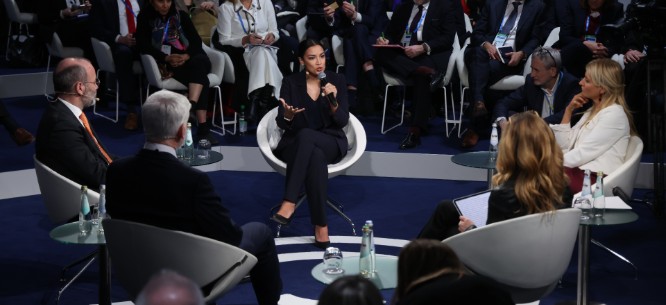
The most constructive outcome of Donald Trump’s second term would be to galvanize a global constituency to deepen democracy. By knocking out key pillars of the postwar order, Trump has exposed its fragilities and forced a reassessment of how the United States engages the world. The next Democratic president will need to project a different vision rooted in transnational solidarity and strategic humility. Few national political figures have begun to articulate such a reorientation as clearly as Representative Alexandria Ocasio-Cortez.
Taken together, Ocasio-Cortez’s early foreign policy pronouncements provide a window into what a progressive rethinking of American internationalism might look like. They suggest a healthy break with both the reactionary nationalism of Trump and the complacencies of the bipartisan establishment. She has consistently linked U.S. military aid to human rights compliance. She has pressed for climate commitments to anchor trade and development policy, and she has framed migration as a hemispheric structural challenge—not just a problem of border security. She also unequivocally refers to Israeli actions in Gaza as a genocide, and has denounced the “depravity” of U.S. policy toward Cuba. These positions point toward a foreign policy that is less deferential to entrenched orthodoxies and more explicit about conditioning American power. “I will not support Congress sending more taxpayer dollars and military aid to a government that consistently ignores international law and U.S. law,” she declared in late March in opposition to any future military aid to Israel. This is precisely the message progressives will need to carry into the post-Trump world.
The significance of these interventions lies not only in the policies they advance, but in the model of political engagement they imply. An outsider to her party’s establishment from the outset, Ocasio-Cortez entered national politics through insurgent, grassroots mobilization. This origin story clearly distinguishes her from any of Trump’s would-be successors—and it has informed her early foreign policy moves. She has already demonstrated an eagerness to engage political actors that high-level U.S. officials routinely overlook, from social movements and labor organizers to a new generation of left-wing leaders across the Americas. During a 2023 congressional delegation to South America, for example, she stressed dialogue with activists and community leaders alongside conversations with government officials, using the trip to acknowledge the historical grievances that continue to shape the hemisphere’s relationship with Washington. That disposition will be critical to rebuilding trust in a world that understandably sees the United States as a rogue actor.
But restoring credibility abroad will require more than rhetoric. Allies and adversaries alike have watched the country oscillate sharply between Democratic governments and hard-right leadership, producing abrupt reversals on climate policy, the Iran nuclear deal, and strategic commitments—including Ukraine. The resulting whiplash has weakened confidence in the durability of American promises as such.
A first step for any progressive leader is to confront the ways economic policy has been insulated from democratic scrutiny. At the Munich Security Conference in February, Ocasio-Cortez noted that, “oftentimes, our trade agreements are used as a back door to pass policies that would never be tolerable in domestic politics, certainly in the United States.” A genuinely progressive foreign policy must therefore insist that global economic rules serve workers rather than narrow corporate interests—and that the dignity of working people everywhere, not just Americans, is treated as a core objective of international cooperation.
This critique points to a broader problem: the distance that separates U.S. foreign policy from democratic accountability at home. When American policy is insulated from democratic constraint, U.S. power looks less like the defense of shared principles and more like the pursuit of narrow interests. Restoring trust abroad is therefore inseparable from democratizing foreign policy at home. With that in mind, Ocasio-Cortez’s surprise 2018 primary victory over a ten-term incumbent was not merely an upset, but a demonstration of political method. Like Zohran Mamdani, whom she supported in his successful New York mayoral run last year, Ocasio-Cortez assembled a coalition that bridged generational, racial, and class divides, pairing digital mobilization with face-to-face organizing and turning marginal constituencies into key parts of her base. Her campaign converted diffuse frustration into structured participation. Any progressives hoping to reshape U.S. foreign policy will need to draw on similar instincts, grounding international commitments in democratic accountability at home and sustained engagement with social movements abroad.
To be sure, a foreign policy organized around this strategic humility does not eliminate the difficult tradeoffs confronting a global power. Any progressive president will have to collaborate with forces on the left and right on discrete issues, while maintaining a clear normative compass. This makes for an occasionally messy discourse. Critics quickly seized on Ocasio-Cortez’s remarks in Munich—including her halting answer on Taiwan—as evidence that the left lacks a coherent answer to the most difficult dilemmas of contemporary geopolitics. Much of that criticism, particularly from opponents on the right, was offered in bad faith, but it points to real underlying questions. Any U.S. administration—progressive or otherwise—would be burdened by the weight of U.S. imperialism. Tensions surrounding American policy toward Taiwan, the future of the Western Hemisphere, Iran, or the ongoing catastrophe in Israel/Palestine will not yield easy solutions simply because Washington adopts a more ethical vocabulary.
Acknowledging those constraints, however, should not obscure a deeper point. The dominant framework guiding U.S. foreign policy since the end of the Cold War has treated American primacy as both natural and indispensable, discouraging serious debate about the costs and consequences of maintaining it. Ocasio-Cortez and other progressive voices are beginning to challenge that presumption. Rather than assuming that the credibility of U.S. power rests primarily on demonstrations of military resolve, they have emphasized the importance of legitimacy, and the idea that global partnerships ultimately endure only when they are perceived as serving broadly shared interests rather than narrow geopolitical advantage.
That principle also implies a different style of diplomacy. Ocasio-Cortez has exemplified what this approach could look like. Her 2023 congressional delegation to South America, for instance, emphasized listening over lecturing. In Brazil, she explicitly linked the January 6 attack in Washington, D.C. to the January 8 assault on democratic institutions in Brasília, arguing that if reactionary movements are global, progressive movements must be as well. Her visit to Sol Nascente, Brazil’s largest working-class favela, was especially revealing. There, she toured a community kitchen organized by the Homeless Workers’ Movement alongside Guilherme Boulos, a longtime MTST leader then serving in Congress and now a member of President Inácio Lula da Silva’s cabinet. Boulos is one of the Brazilian left’s most visible national figures, representing a new media-savvy generation of leadership that is both movement-based and unapologetically redistributive. Both Boulos and Ocasio-Cortez have based their politics in engagement with transnational networks of activists, municipal leaders, and social movements. Whoever assumes the progressive mantle in 2028 must incorporate this lesson into their foreign policy thinking as well. Foreign policy, in short, must not be an afterthought to a progressive domestic agenda but a direct extension of it.
The participatory ethic that animated Ocasio-Cortez’s breakthrough 2018 campaign, grounding power in organized communities in order to contest insulated elites, can also shape a left-wing foreign policy. It will be particularly important to recognize that democracy means something deeper than electoral procedure. It is a lived practice sustained by activists, workers, Indigenous communities, and urban organizers around the world. The framework that she has begun to articulate offers a glimpse of how the United States might reengage the world—not as an unquestioned hegemon, but as a democratic partner in a shared struggle to preserve and deepen democracy.
That premise produces a broader critique of contemporary international politics. As Ocasio-Cortez warned in Munich, the current administration seeks to “withdraw the United States from the entire world so that we can turn into an age of authoritarianism,” and to use the Western hemisphere as a “personal sandbox.” Her language signaled an unmistakable rejection of both grievance-driven nationalism and the logic of spheres of influence. But she also challenged the complacencies of the pre-Trump status quo. Democracies, she argued, cannot defeat authoritarian populism by invoking procedural norms, even as they tolerate economic systems that hollow out working- and middle-class security. They must deliver “material gains for the working class,” linking wages, climate transition, and social protection to democratic resilience. The recent defeat of Viktor Orbán in Hungary underscores this dynamic. In that case, a broad and ideologically diverse coalition was able to unseat a deeply entrenched authoritarian nationalist regime by channeling discontent over corruption and economic decline, demonstrating that such authoritarian projects are indeed reversible. Their lasting defeat, however, depends on delivering the material gains that sustain democratic legitimacy. Mexican president Claudia Sheinbaum understands this dynamic, recently advancing universal healthcare not only as social policy but as a foundation for democratic legitimacy rooted in material inclusion.
The primary challenge to the well-being of most Americans does not emanate externally from Moscow or Beijing. It is ultimately internal, rooted in decades of inequality and policy choices that have eroded trust in governing institutions. The implication is clear: renewing democratic legitimacy requires an agenda of structural redistribution.
The question is where the political foundations for such an agenda might come from. Critics often describe the U.S. foreign policy establishment as a monolithic “blob” of officials, think tanks, contractors, and media voices that has long set the boundaries of debate in Washington. Yet, over the past decade, a countercurrent has begun to take shape. Climate justice groups such as the Sunrise Movement and the Climate Justice Alliance have pushed policymakers to treat decarbonization as a pillar of economic diplomacy. Labor federations including the AFL-CIO and the International Trade Union Confederation have pressed for stronger labor standards in trade agreements and greater scrutiny of global supply chains. On Capitol Hill, lawmakers such as Bernie Sanders, Chris Murphy, Ro Khanna and Pramila Jayapal—in addition to Ocasio-Cortez herself—have echoed these concerns, calling for tighter oversight of arms sales and a closer alignment between climate, development, and economic policy.
These political currents are increasingly reinforced by a growing policy infrastructure. Institutions such as the Quincy Institute for Responsible Statecraft and advocacy networks like Win Without War, the Center for Economic and Policy Research, the Center for International Policy, and Demand Progress have begun building an intellectual and organizational infrastructure for alternatives to post-Cold War U.S. primacy. None of these actors alone can reshape American grand strategy, but together they suggest that the terrain of debate is more fluid than previously imagined. Climate activists, labor organizers, immigrant advocates, and policy analysts advocating restraint are increasingly part of the same conversation, forming the beginnings of a coalition capable of sustaining the reorientation that Ocasio-Cortez has begun to articulate.
Presidential campaigns are the moments when such coalitions can redefine the terms of foreign policy debate. Whoever wears the progressive mantle in 2028 will need to connect these currents of change, and treat foreign policy not as a technocratic sphere insulated from domestic politics but as an extension of democratic struggle at home. The networks already pushing for climate justice, labor rights, and democratic accountability could provide the social foundation for a new kind of American internationalism: one less invested in preserving dominance than in building partnerships capable of addressing the shared crises of the twenty-first century. Few American politicians have begun to sketch that possibility as clearly as Ocasio-Cortez. Whether she ultimately leads such a project herself or helps shape it from within a broader movement, the framework she has outlined offers a glimpse of what a progressive foreign policy might look like in the years to come. Others should take note.
Andre Pagliarini is assistant professor of history and international studies at Louisiana State University, a fellow at the Washington Brazil Office, and non-resident expert at the Quincy Institute for Responsible Statecraft. His latest book is Lula: A People’s President and the Fight for Brazil’s Future.