A Tale of Two Plumbers
A Tale of Two Plumbers
Hannah Spencer’s victory in a UK parliamentary by-election is a major win for the Green Party, which aims to build a viable left-populist alternative to Reform UK and Keir Starmer’s Labour Party.
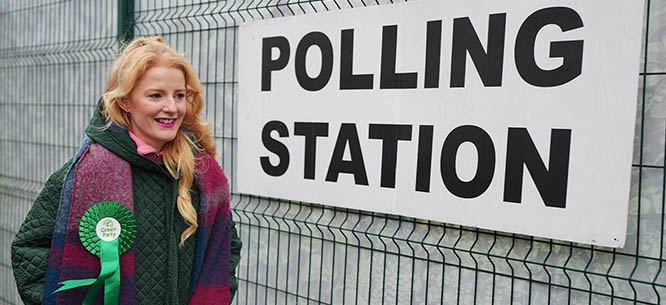
Hannah the Plumber is going to Parliament. The Green Party candidate’s stunning victory in Gorton and Denton was in a previously “safe” seat for the Labour Party, which had held it for nearly 100 years. But yet another political blunder by deeply unpopular prime minister Keir Starmer—this time, blocking the popular Greater Manchester mayor Andy Burnham from running—turned the election for a vacant parliamentary seat into a three-way toss-up that, on the day, wasn’t even particularly close. Hannah Spencer, a thirty-four-year-old who left school at sixteen to become a plumber, took more than 40 percent of the vote, winning 4,000 more votes than the next-place finisher, right-wing gadfly Matt Goodwin of the pseudo-populist party Reform UK. The Labour Party’s third place was, frankly, embarrassing.
Following the loss, Starmer whined about extremists to his left and right exploiting “grievances,” an indication that he would stick with his favorite posture, that of the Serious Centrist. (“He’s completely incurious. He’s not interested in policy or politics. He thinks his job is to sit in a room and be serious,” a former aide told the Spectator recently.) Labour’s National Executive Committee said it blocked Burnham from running because it did not want another election for the mayoralty Burnham would vacate if he won, but it is widely assumed that the real reason was that Burnham is considered a contender for Starmer’s role when he, inevitably, goes.
But enough about Starmer. This win belongs to Hannah Spencer, and Green Party leader Zack Polanski, and hundreds of canvassers who crisscrossed the district and got out the vote for a left-populist alternative under the banner “Hope Not Hate.” On her Instagram after the results were announced, Spencer posted a graphic that declared “Hope Wins!” In her victory speech, she apologized to her plumbing customers, saying, “I’m sorry, but I think I might have to cancel the work that you had booked in, because I’m heading to Parliament. And when I get there, I will make space for everyone doing jobs like mine.”
As the economist and Green candidate James Meadway put it just before the election, with the ascent of Polanski (himself also from the Manchester area), the Greens have aimed to put forward a message that understands “the realities of life in Britain today, including the reality of the left’s core base of support: the young and disenfranchised, often insecurely employed, often university educated, often to be found in the major towns and cities. This is part of a new working class, but one that has little to no attachment to the history or the institutions of the labour movement.” Spencer walks the line between the new and old working class: a woman in the male-dominated building trades, a millennial who turned to politics while also returning to education to learn gas engineering and plastering, hoping to add to her plumbing business. It was economic inequality that spurred her to run for office, and by 2023, the party that appeared to actually care about that issue was the Greens.
“I didn’t grow up wanting to be a politician. I am a plumber,” she said in her speech. “Except things have changed a lot over the last few decades, because working hard used to get me something. But now working hard, what does that get you? . . . Instead of working for a nice life, we’re working to line the pockets of billionaires. We are being bled dry.”
As an American living in Britain, I couldn’t help but think of another famous political plumber. Back in 2008, when Barack Obama was facing off with John McCain for the presidency, a man named Samuel Wurzelbacher went viral for asking Obama if he would face a tax hike if he bought a plumbing business. Wurzelbacher became known as “Joe the Plumber” despite being neither named Joe nor, it turned out, a licensed plumber.
Joe the Plumber became McCain’s favorite talking point on the campaign trail and made quite a few appearances himself. In one subsequent presidential debate, Joe received twenty-five mentions—more than “the economy” and the Iraq war together. Before Trumpism, even before the Tea Party, there was Joe the Plumber.
Wurzelbacher loved God and guns and hated taxes, unions, and foreigners. The campaign over, his enemy in the White House, he published a book, started a blog, and ran (unsuccessfully) for Congress, calling for (pre-Trump!) a border wall and “for US agents to ‘start shooting’ immigrants suspected of illegally entering the US.” When video fame and the content machine failed to pay the bills, he briefly took a union job at a Chrysler factory, and naturally he supported Donald Trump. On his fourth day at work, according to the Toledo Blade, he was “accosted” by a fellow worker as a “teabagger.”
As Chris Lehmann noted in 2023, when Wurzelbacher died aged just forty-nine, “Joe the Plumber was tailor-made for the role of representing a forgotten-man brand of right-wing cultural reaction masquerading as straightforward economic grievance.” That it was mostly a pose is even more appropriate: the fetishization of working-class identity that produces figures like Joe the Plumber has almost nothing to do with the real lives of struggling workers today. Rather, right-wing populism plays to an imagined middle, offering an identity politics that assumes that white masculinity and working-classness are synonymous. As David Roediger argued in The Sinking Middle Class, appeals to the “white working class” serve to discipline the broader proletariat: “They teach us what is impossible to demand and, in doing so, account not for the opinions of white workers in general, but specifically those of the white workers who are most reactionary.” When the term “white working class” comes up, he wrote, “the accent will always fall on ‘white’ and the mumbling on ‘working class.’”
But, as British scholar Joe Kennedy noted in his book Authentocrats, right-wing politicians aren’t the only ones who make this obvious slip. The center-left too often falls into the same trap: recall a moment earlier in the 2008 election, when Hillary Clinton did a shot of whiskey and praised “hard-working Americans, white Americans,” who might prefer her to her opponent.
Populisms of the left and the right have both, Michael Kazin argued in The Populist Persuasion, relied on the trope of producerism: the hardworking many against the parasitical few. Today populists of the left, like Spencer and Polanski, point to the billionaire class, profiting off the labor of workers who struggle to pay the rent. Their right-wing counterparts, like Reform’s Nigel Farage and Matt Goodwin, tend to portray their supporters as a squeezed middle stuck between the cultural elite on the one hand, and a racialized poor on the other. Goodwin did not disappoint on this front, wheezing after his loss about the “coalition of Islamists and woke progressives” that did him in. Farage’s strategy, Meadway wrote, has been to scarper around the country “talk[ing] up the nobility of manual work and trade unionism” while his base is fed on “24/7 far right ragebait and GB News clips.” Meanwhile, his party is embracing Conservative defectors and putting them in charge of economic policy, which is anything but favorable to working people.
We might note the rich irony of Farage and Goodwin, a second-generation financier and an academic, claiming to be anything other than elites, except the rise of Trump should disabuse us of any notion that authenticity or even honesty matters much to today’s would-be populist right. Rather, we should recall that centrists from Clinton to Starmer have been all too willing to embrace the same conservative framing and actions. The same day that Spencer won, the Financial Times noted that Starmer’s hopes for economic growth were being hindered by a “self-inflicted problem”: his own immigration policies.
Whether Starmer and his cabinet have been duped by Reform’s bait-and-switch or whether reactionary immigration policy is their natural bent matters little: after Spencer’s big win, they could be toast. Popular opinion assumes the current Labour government will stagger on until May’s local elections when the knives will come out in force. Most expect the party to force a leadership contest to replace Starmer as prime minister—a battle likely to be between the party’s even further right and what little remains of its left.
For now we know that Hannah the Plumber is heading to London, where she will attempt to help build an eco-populist party that is starting to look like a real electoral threat.
Sarah Jaffe is a member of Dissent’s editorial board and the author of From The Ashes, Work Won’t Love You Back, and Necessary Trouble. She now lives in London.