The Kerala Consensus
The Kerala Consensus
How did a society segregated by caste, class, and religion become an egalitarian community?
The Left Front, a coalition of parties led by the Communist Party of India (Marxist), was elected in my home state of West Bengal in 1977 and stayed in power for thirty-four years. When I was growing up, its permanence seemed no less solid than the stars and the moon. As late as 2004 Communist parties held fifty-three of 545 seats in the Indian parliament. Twenty years later, in the 2024 election, the three Communist parties together won eight seats. As their vote share shrank, the Hindu nationalist Bharatiya Janata Party rose, and the center-left Congress became largely indistinguishable from the BJP on economic questions. Both parties worked to privatize state assets, remove licensing restrictions on domestic businesses, and woo multinational capital in a global race to attract foreign corporations. In Bengal, the Left Front’s economic policies in the 2000s followed a similar path, and it used eminent domain laws to seize agricultural land from sharecroppers to give to domestic and international firms. Violent confrontations over land rights in Singur and Nandigram led millions of the Left Front’s traditional voters—from street vendors and auto-rickshaw drivers to small farmers and sharecroppers—to abandon the coalition, culminating in its defeat in 2011.
The story is different in Kerala, the Indian state that has seen the Communist Party’s most impressive and enduring achievements. Home to 35 million people (larger than Sweden, Norway, Finland, and Denmark combined), it has long been admired and studied across the world as a model of human development for its high levels of education, health, and civic engagement, combined with low income inequality. Moreover, Kerala is a heterogenous society, with religious diversity—25 percent of the population is Muslim, 20 percent is Christian, and 55 percent is Hindu—and many different caste and ethnic communities.
Kerala’s accomplishments are even more remarkable because India is one of the most unequal countries on earth, and income inequality has consistently been worsening over the last two decades. Across the country, more than 10 percent of the population is below the Indian government’s poverty line; in Kerala, it’s less than 1 percent. The state government is determined to reduce the number even further. In recent years, it has undertaken multiple schemes to protect the people in this group. This year it announced that it had eliminated the “extreme poverty” of the 64,006 most vulnerable families, including those who are homeless, lack assets, or have lost their main income earner through illness or death. This milestone was achieved by local governments, which identified families in each village and municipality and offered them housing, income, and healthcare. Policymakers may debate whether extreme poverty has been “eradicated,” but that discussion is partly academic. There is an enormous gap between Kerala and the rest of India in addressing poverty and rising inequality.
Kerala was not always such an equal place. Until the mid-1800s, 13 percent of the population was enslaved, with most working on plantations. The end of slavery changed little for most members of slave castes, who labored as sharecroppers on plantations and suffered social stigma and exclusion into the twentieth century.
How did a society segregated by caste, class, and religion become an egalitarian community? The answer has to do with food. During the Second World War, a rice famine threatened the region. Much of the rice consumed in Kerala was imported from Burma, which had been conquered by the Japanese. In Bengal, the British created famine conditions by hoarding rice and diverting grain for its war effort, causing the deaths of 3 million people. In Kerala, members of the newly formed Communist Party of India mobilized mass agitations across the region to prevent hoarding by speculators, establish local grain banks, and distribute rice through a rationing system that stretched into every village. While the rations were meager and many experienced hunger, a famine was averted, and by the time India became independent in 1947, Kerala had established the Public Distribution System. These measures to protect people from hunger became popular across caste and religion, and the people of Kerala voted the Communists to power in the state’s first election in 1957.
Once in government, the Communists championed land reforms. They were not entirely successful in seizing and redistributing land, but they enforced existing federal laws to limit the size of landholdings and ensured tenants’ rights by registering sharecroppers. More crucially, the government instituted a law to allow all sharecroppers to own their own shack and the land on which it stood. Even without a field of one’s own, a home of one’s own was a dramatic transformation. It made over 90 percent of Keralites homeowners, giving them a place in the world and an asset that they could grow.
For years, governments in Kerala spent as much as 30 percent of the annual budget on public education. They created libraries in every village and literacy movements of volunteer educators to ensure that every adult—even former laborers and sharecroppers—learned to read and write. They established public health clinics in every village and focused especially on maternal care, children, and the elderly. By the 1970s Kerala had literacy, life expectancy, and infant mortality rates that matched countries in Europe, even though its income level matched the rest of India. Development scholars like Amartya Sen have lauded the unique features of the “Kerala model,” which challenged economists’ assumptions that wealth or income level is the best (or only) measure and predictor of human welfare or societal well-being. In the 1990s, the United Nations Development Programme created a Human Development Index, based largely on the Kerala model, which measures health and education alongside income to establish a country’s level of development.
The Communists have been in and out of power in Kerala (they have governed the state for thirty of the past sixty-eight years). Yet even after the fall of the Soviet Union, Communist-led coalitions have returned to power in roughly every other election cycle, alternating with Congress-led coalition governments. These coalitions may have different voter bases, but they vary little in substance. All parties govern from a shared consensus about health, education, and welfare policies that are responsive to people’s evolving needs. Some leftists have criticized the Communist successes in Kerala as ideologically compromised. It’s true that in some ways, Communist-led governments in Kerala have rejected ideological orthodoxy, which has allowed them to better serve their constituents. This can be seen in consensus welfare and economic policies, but also in how the party approaches religion. Kerala has long been one of the most devoutly religious parts of India, and Communists there have learned to be pragmatic and tone down their anti-religiosity—a lesson that the more ideological left in India failed to learn. Instead of waging cultural battles, the Kerala Communists understand each election as part of an ongoing fight to provide schools, clinics, food, sources of credit, small business licenses, and security and dignity for all people.
In Kerala there is no difference in development outcomes across regions or between city and countryside. And in terms of health and education, the three major religious groups are roughly equal, unlike in states like West Bengal, where there are vast differences between the socioeconomic status of the Hindu majority and Muslim and Christian minorities. This was achieved by conscious steps to devolve power. In Kerala there was an effort to make sure government policies in education, health, and other areas were administered equitably by the people themselves, through local governments in every village, instead of by bureaucrats in the state capital.
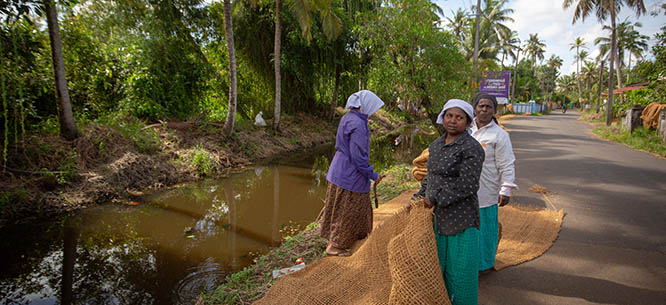
In the 1990s, for example, Kerala engaged in a radical participatory planning experiment across municipal and village councils. State funds were redistributed to local governments as thousands of people took part in deliberations on how to best plan for the needs of their communities. This was in stark contrast to the tradition of Indian state planning, which was usually conducted by unelected experts in New Delhi or the state capitals. The experiment spawned myriad new local policies and programs such as a zero-waste movement to end all dumping, spatial planning for women’s safety, rainwater harvesting, construction of natural dams, palliative care for the elderly, and new workers’ and farmers’ cooperatives. In its aftermath, the government initiated a massive statewide program to increase women’s employment. Instead of a top-down scheme, the Kudumbashree, as the program was known, was administered locally through village councils that helped women to find salaried jobs and to start their own small businesses. Following the Kudumbashree, more women entered politics across the state. The recent program to eliminate extreme poverty was administered in a similar way through local governments. It too provided specific, targeted help—to renovate a home or to start a small shop—to the most vulnerable families.
Kerala shows that if people are protected from risk and uncertainty by a government that provides access to food, housing, a decent education, and basic healthcare, they will be motivated to take care of many other problems. What people need changes over time, and a successful political system must be responsive. It isn’t a specific policy or ideology that underpins the Kerala model; it’s the vision of a unified society, built on shared values and commitments. That includes a commitment to the welfare of each person in the society, rural or urban, Muslim, Christian, or Hindu, regardless of caste. The lesson is simple: give people the power to shape policies where they live and work, and they will make the changes they need.
Kushanava Choudhury is the author of The Epic City: The World on the Streets of Calcutta (Bloomsbury, 2018). His new narrative nonfiction book, The Big Love, about structural inequality in India and Kerala’s story of social transformation, will be published this year.