The Kerala Consensus
The Kerala Consensus
How did a society segregated by caste, class, and religion become an egalitarian community?
The Left Front, a coalition of parties led by the Communist Party of India (Marxist), was elected in my home state of West Bengal in 1977 and stayed in power for thirty-four years. When I was growing up, its permanence seemed no less solid than the stars and the moon. As late as 2004 Communist parties held fifty-three of 545 seats in the Indian parliament. Twenty years later, in the 2024 election, the three Communist parties together won eight seats. As their vote share shrank, the Hindu nationalist Bharatiya Janata Party rose, and the center-left Congress became largely indistinguishable from the BJP on economic questions. Both parties worked to privatize state assets, remove licensing restrictions on domestic businesses, and woo multinational capital in a global race to attract foreign corporations. In Bengal, the Left Front’s economic policies in the 2000s followed a similar path, and it used eminent domain laws to seize agricultural land from sharecroppers to give to domestic and international firms. Violent confrontations over land rights in Singur and Nandigram led millions of the Left Front’s traditional voters—from street vendors and auto-rickshaw drivers to small farmers and sharecroppers—to abandon the coalition, culminating in its defeat in 2011.
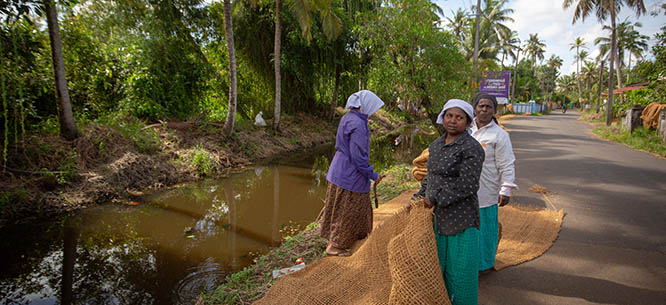
The story is different in Kerala, the Indian state that has seen the Communist Party’s most impressive and enduring achievements. Home to 35 million people (larger than Sweden, Norway, Finland, and Denmark combined), it has long been admired and studied across the world as a model of human development for its high levels of education, health, and civic engagement, combined with low income inequality. Moreover, Kerala is a heterogenous society, with religious diversity—25 percent of the population is Muslim, 20 percent is Christian, and 55 percent is Hindu—and many different caste and ethnic communities.
Kerala’s accomplishments are even more remarkable because India is one of the most unequal countries on earth, and income inequality has consistently been worsening over the last two decades. Across the country, more than 10 percent of the population is below the Indian government’s poverty line; in Kerala, it’s less than 1 percent. The state government is determined to reduce the number even further. In recent years, it has undertaken multiple schemes to protect the people in this group. This year it announced that it had eliminated the “extreme poverty” of the 64,006 most vulnerable families, including those who are homeless, lack assets, or have lost their main income earner through illness or death. This milestone was achieved by local governments, which identified families in each village and municipality and offered them housing, income, and healthcare. Policymakers may debate whether extreme poverty has been “eradicated,” but that discussion is partly academic. There is an enormous gap between Kerala and the rest of India in addressing poverty...
Subscribe now to read the full article
Online OnlyFor just $19.95 a year, get access to new issues and decades' worth of archives on our site.
|
Print + OnlineFor $35 a year, get new issues delivered to your door and access to our full online archives.
|