The Heaven of Train Travel
The Heaven of Train Travel
Passenger rail is being remade as a luxury lifestyle product—suggesting the problem isn’t trains, but the indignity of using them when they are so badly run.
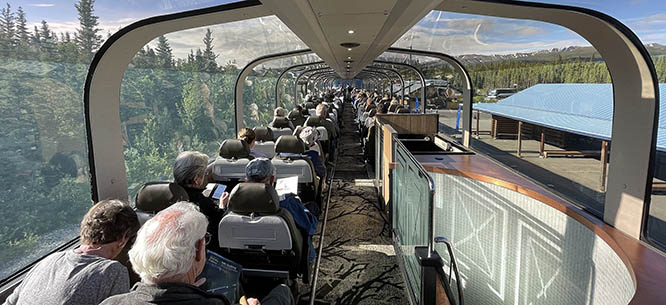
The Silver Meteor pulls out of Miami’s Amtrak station on time at 8:10 a.m. It rumbles past the sun-bleached industrial landscape, and the large car window is lit up by the low-lying autumn rays. “Have a Safe and Productive Day” reads a squat white wall, directed at the train cars and framed by palm fronds and power lines. I do the opposite: close my laptop, close my book, and remember Robert Louis Stevenson’s words—“And ever again, in the wink of an eye, / Painted stations whistle by”—as my co-passengers and I zip past Hollywood, then Fort Lauderdale, then Deerfield Beach. The fluorescent lights illuminate an interior of scuffed vinyl and tired textiles, but extra-wide seats and expansive windows make up for these deficiencies. I take out wool and needles and start to knit a vest, measuring the journey in centimeters of fabric; stations tick by in tidy rows of stitches.
The train is much slower than I’m used to. I grew up with Eurostar, Eurotunnel, and the UK’s High Speed 1. As the landscape beside the Silver Meteor unfolds, I pause to text Louisa in New York a photo of the station in Delray Beach, where her grandmother lives, then a video as I’m whizzing away. “Hey, how peaceful is that?” she writes. The train carries on reverberating up the East Coast with “movement . . . so continuous . . . the mind accepted it as stillness,” as Graham Greene once wrote. Amtrak is crumbling, I’m told, after decades of disinvestment. So why does this feel like such a luxury?
“Walking was pleasurable, cycling enjoyable, bus journeys fun. But the train was very heaven.” Historian Tony Judt was sentimental about train travel, but he also saw it as the foundation of modern life. “The conquest of space led inexorably to the reorganization of time,” he wrote in “The Glory of the Rails,” published posthumously in the New York Review of Books in 2010. The train schedule was a civic promise.
The railways transformed the industrial world. They allowed us to reconceptualize the landscapes and distances through which we could now travel, and for the first time, people traveled together en masse, albeit often separated by class. But since the 1950s, the promise of train travel has been repeatedly broken. Cheap oil, the cult of the car, publicly subsidized interstates and ring roads, low-cost flights, privatization—each chipped away at what made rail systems an important public good. We built a petroleum society and told ourselves it was freedom.
Chronic underfunding of rail travel has led to patchwork systems. The United States “nationalized” passenger rail in 1971 with the creation of Amtrak (the National Railroad Passenger Corporation)—a federally chartered, quasi-public operator that took over intercity passenger trains from the private railroads. But this was a rescue, not a renaissance. Amtrak was starved, asked to run mostly on privately owned tracks...
Subscribe now to read the full article
Online OnlyFor just $19.95 a year, get access to new issues and decades' worth of archives on our site.
|
Print + OnlineFor $35 a year, get new issues delivered to your door and access to our full online archives.
|