The Dignity of All People
The Dignity of All People
Zohran Mamdani’s successes and failures will shape how people around the country think about the viability of a socialist program, and whether socialists are capable of enacting it.

“Socialism is the name of our desire,” Dissent’s founders stated in 1954. It was an ethical and moral demand, a compass rather than a map. It was a “vision,” they wrote, “that gives urgency to . . . criticism of the human condition in our time.”
One purpose for Dissent was to rescue the idea of socialism from those who claimed it for authoritarian ends. And that points to a problem with our vocabulary. Across the globe, a few big concepts define political orientations: liberalism, socialism, capitalism. But each of these categories contains multiple meanings, including internally contradictory ones. There are struggles between ideological camps, of course, but there are also struggles within them over how to define these categories for the public. The ways that people understand the meaning of political words is, alas, derived less from the work of intellectual magazines and more from experiences with politicians who claim them.
That brings us to the remarkable victory of Zohran Mamdani. In a lightning round of questions before his election, MSNBC host Ari Melber asked Mamdani to complete the sentence: “I am a democratic socialist because . . .” Mamdani quickly answered, “I believe in the dignity of all people.” His facility with modern mass media and his role as the executive of a major city give him a chance to define the meaning of socialism for new generations.
Mamdani has a threefold challenge in communicating this definition to the public. First, he needs to establish that democratic socialism is a noble tradition; second, that belonging to it distinguishes him from others on the political scene; and third, that it is a perfectly normal political category. In many other places around the world, socialists participate in democratic politics without fuss. Even the United States has had plenty of revered socialists, like Helen Keller and Martin Luther King, Jr., though they are taught to children as advocates on behalf of other worthy causes. For reasons of both political culture (an identification of “Americanism” with anti-radicalism) and political structure (a system in which people with social democratic politics are “hidden” on the left wing of the Democratic Party), the meaning of a socialist tradition as a vehicle for mass politics in the United States remains open.
We are accustomed to Republicans characterizing socialism as anti-American, but many Democrats are also anxious about what it will mean for their party to be associated with popular and charismatic socialists. They would be wise to recognize that the success of socialist politicians brings with it opportunities as well as challenges. There are plenty of voters—including refugees from authoritarian countries that call themselves socialist—for whom the term is permanently sullied. But there are many people who identify socialism with Bernie Sanders, Alexandria Ocasio-Cortez, and Mamdani. For them, it offers an organizing identity outside of mainstream liberalism—even as democratic socialists accept and seek to improve liberal political institutions—which matters because liberalism is often perceived as an establishment ideology. Philosophically, a liberal should be committed to the “dignity of all people,” which is what makes them our coalition partners. But liberals in power often have not been. Sanders, AOC, and Mamdani communicate that they care about fighting for working people, not the interests of a party per se. That can be a potent political asset.
Up to now, insurgent socialists have had the advantage of contrasting their theoretical programs with actually existing liberalism. But with Mamdani taking office, voters will be able to judge the merits of actually existing socialism too. His failures and successes will shape how people around the country think about the viability of a socialist program, and whether the people who identify as socialists are capable of enacting it.
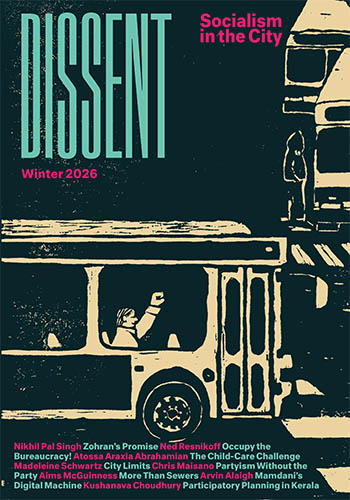
Articles in the special section of this issue examine the challenges of municipal socialism—past, present, and future. Aims McGuinness pulls Milwaukee’s legendary “sewer socialism” out of the realm of myth and into reality, examining its tensions and greater aspirations. Kushanava Choudhury looks at subnational democratic left politics through long-term investments in human welfare in the Indian state of Kerala. Madeleine Schwartz writes a cautionary letter from Anne Hidalgo’s Paris, a city that works beautifully in many ways but remains unaffordable.
Turning to New York, Nikhil Pal Singh reminds us that Mamdani’s victory was built on a more inclusive vision of politics. Chris Maisano and Arvin Alaigh argue that sustaining enthusiasm requires retaining a commitment to community, through both physical and digital infrastructure. Atossa Araxia Abrahamian looks at the challenges of maintaining a political horizon that includes not just roads, bridges, and trash pickup, but the work of care. And Ned Resnikoff makes the case that the left must take bureaucracy seriously.
At Dissent, our role is to provide intellectual resources for an effective democratic left. These pieces are a part of that work. The compass direction is set where it has always been. But our values are linked to a political movement that, at least in the United States, is as large as it ever has been. We will do our part to map the terrain.
Patrick Iber is co-editor of Dissent.