The Bronx Still Burns
The Bronx Still Burns
The borough’s arson wave in the 1970s was caused by financial forces and political priorities that continue to hold power in New York City.
Born in Flames: The Business of Arson and the Remaking of the American City
by Bench Ansfield
W.W. Norton, 2025, 368 pp.
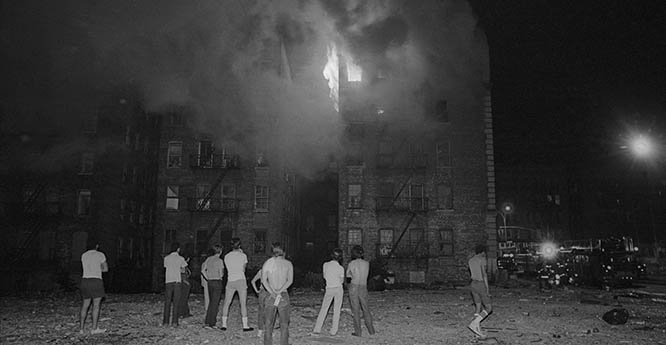
Last summer, the Bronx was burning. In July, as a heatwave smothered the Eastern Seaboard, the temperature in New York City’s poorest borough reached a record-setting 100.6 degrees Fahrenheit. Extreme heat kills over 500 New Yorkers each summer, when crowded, shadeless neighborhoods become furnaces and pressure-cookers. No borough is more vulnerable to heat-related deaths than the Bronx, where residents—85 percent of whom are Black or Hispanic—suffer from higher rates of asthma and diabetes, are more likely to work outdoors, and have less air conditioning access than people living in other boroughs.
A hundred miles east, in the Hamptons, the climate crisis has also arrived for New York’s ultrarich. Rising sea levels and more frequent hurricanes have tripled the cost of property insurance; industry groups warn that this summer playground will become an insurance “desert” if the government doesn’t intervene. As access to private coverage evaporates, the New York Property Insurance Underwriting Association—the state’s “insurer of last resort”—has stepped in to fill the void. In summers ahead, as deadly heat scorches the Bronx, the mostly white homeowners in the Hamptons will rest easier knowing their properties are protected during hurricane season by a public-private resource provided by New York State.
In the last few decades, inequality in the United States has been redefined by uneven exposure to climate disaster. Yet long before the surge in dangerous weather events, the private insurance market reinforced the vulnerability of poor Americans by exacerbating rather than mitigating risk. In Born in Flames: The Business of Arson and the Remaking of the American City, historian Bench Ansfield investigates the infamous arson wave that engulfed the Bronx in the late 1960s and burned for over a decade. Contrary to the popular myth that residents torched their own neighborhoods, Born in Flames explains how failed regulation and the government’s misplaced faith in the market all but guaranteed the Bronx would burn. “The arson wave came to an end only because those whose homes lay in its path mobilized and fought back,” Ansfield argues. Today, this historical legacy lives on in a sacrificial economy that secures private wealth and property while leaving the urban poor exposed to chance. As homeowners in the Hamptons demand an even greater share of public attention, the Bronx faces the hazards of a warming planet under conditions of financial predation and state neglect.
Nearly fifty years after the arson wave ended, images of the burning Bronx have been seared into public memory by Hollywood films and Netflix documentaries, at least one TV miniseries, and bestselling popular histories like Jonathan Mahler’s Ladies and Gentlemen, the Bronx Is Burning. Above all, the destruction has been explained as a chapter in New York’s fiscal crisis and as an extension of the fiery urban rebellions of the 1960s. Such narratives obscure both the national scope of the arson problem and its bearing on the present. “The torching of wide swaths of the American metropolis,” Ansfield argues, was both a symbol and manifestation of how the rise of FIRE (finance, insurance, and real estate) industries wreaked havoc on the lives of the poor. For all that the fires destroyed, arson also laid the foundation for a new political economy rooted in housing instability.
Who burned the Bronx? Ansfield shows that most experts in the 1970s arrived at roughly the same answer: those people did it to themselves. Coming on the heels of the 1960s uprisings, they saw the arson wave as validating the work of Daniel Patrick Moynihan, whose reports on Black “social pathology” influenced federal anti-poverty programs under Lyndon B. Johnson and Richard Nixon. Others blamed the fires on drug users, juvenile delinquents, scorned lovers, or welfare cheats looking to qualify for housing assistance. Though the exact details varied, these explanations were “extraordinarily consistent,” Ansfield writes. One way or another, those who lived outside the Bronx blamed the very people “whose lives were torn apart” by arson.
The true origin of the fires lay in Washington, Albany, and New York’s Financial District. Doggedly researched and as gripping as a detective story, Born in Flames is a journey into the underworld of arson. The narrative that scapegoats Bronx residents has been challenged before, including by Vivian Vázquez Irizarry’s 2019 documentary Decade of Fire (for which Ansfield served as a researcher). Born in Flames makes its most important contribution by linking the Bronx’s devastation to the world of finance—specifically “the racially stratified market of property insurance.” Home insurance companies had long discriminated against landlords and homeowners in Black and Latino communities by overcharging for threadbare coverage. But after the 1967 uprising in Detroit, the industry threatened to withdraw from inner cities entirely. The response in Washington was swift. As part of the landmark 1968 Housing and Urban Development Act, Congress established the Fair Access to Insurance Requirements (FAIR) program to lure the insurance industry back to urban centers. FAIR instituted public-private “reinsurance” schemes that enabled insurers to pool their risks and hedge their losses. In exchange, insurers agreed to expand coverage in “riot-prone” areas.
In their effort to reform the insurance industry, lawmakers unwittingly incentivized arson for profit. Ansfield shows how the FAIR plan created a moral hazard by allowing landlords to insure properties for more than the buildings were worth. The resulting “insurance gap” in disinvested areas became “the condition of possibility” for arson. FAIR plans nationwide were responsible for more than $275 million in losses by 1977. The New York Property Insurance Underwriting Association—the entity that today rescues Hamptons homeowners—was among the worst offenders. By 1977, it had amassed $68.5 million in losses. Had it been “a typical private corporation,” Ansfield writes, the NYPIUA would have gone bust. Instead, it staggered on with the blessing of state regulators by spreading its losses across the industry.
In October 1977, President Jimmy Carter visited the Bronx to witness the effects of arson and abandonment firsthand. A famous photograph frames him among vacant apartments, trash, and debris. He looks stunned. A moderate Democrat during the rise of market fundamentalism, Carter was poorly positioned to tackle the nation’s urban crisis. His visit “did jump-start numerous funding streams for community development,” Ansfield writes, but they mostly ended when Ronald Reagan took the White House in 1980. More lasting was an increase in funding for local police and security measures, which only further criminalized Black and Latino youth. In an era defined by austerity and distrust of government, Washington’s emphasis on crime control as the key to urban renaissance was its only genuine policy innovation. Instead of serving as “a testing ground for a robust national urban policy,” the Bronx became a “laboratory” for broken-windows policing and mass incarceration.
Meanwhile, the borough still burned. In the absence of effective regulation, landlords continued to claim insurance payouts. Insurance companies managed to withstand ever-higher losses by raising premiums and reaping the windfalls of financialization. A week before Carter toured the Bronx, the borough’s devastated landscape appeared on national television when ABC repeatedly interrupted Game 2 of the World Series to show a fire raging near Yankee Stadium. According to legend, this was when play-by-play man Howard Cosell declared, “Ladies and gentlemen, the Bronx is burning.” Cosell never actually uttered these words, yet the apocryphal quotation, like Carter’s visit, has come to define this era. Whether they watched the World Series game or saw the president’s picture in the newspaper, the message Americans received was the same: the nation’s largest city was in flames, and no one seemed to know why or how to respond.
The final section of Born in Flames features the perspectives of residents who lived through “the burning years” and met the problem of arson with creativity and collective action. Community mobilization took many forms, from experiments with decommodified housing to protesting notorious slumlords. However, only a strategy that utilized the power of the state could end the arson era.
One moment in which residents wrest control comes during the filming of Fort Apache, the Bronx in the summer of 1980. Apache was the most controversial example of the “Bronxploitation” genre and Hollywood’s lurid fascination with bankruptcy-era New York. Loosely inspired by the 1948 Western Fort Apache directed by John Ford, the film traded a story about settlers and Indians for one in which abandoned cities are the new wild frontier, with Paul Newman starring as the lone good cop in a sea of crime and corruption. Neither Newman nor his producers thought they were making a racist movie, but the production drew outrage. Residents formed the Committee Against Fort Apache and picketed the film set; later, they organized a multi-city boycott. “I don’t like being called a racist pig,” Newman complained while doing press to quell the controversy. The filmmakers ultimately added a disclaimer at the movie’s beginning acknowledging “the law-abiding members of the community” and those “struggling to turn the Bronx around.” Despite these meager efforts, the film’s fortunes never recovered. A would-be blockbuster, Fort Apache, the Bronx opened in 1981 to mixed reviews and disappointing ticket sales.
The Bronx experienced an upsurge of community organizing in this period. Residents joined or formed neighborhood improvement associations, tenant unions, faith-based coalitions, and lobbying efforts. Over a dozen senior citizens volunteered for the city’s Arson Strike Force to investigate suspicious fires using the latest IBM computer mainframes. These efforts are not remembered nearly as well as the many urban homesteading and community development projects that received positive media attention and philanthropic support. Ansfield focuses much of the final chapter on the People’s Development Corporation, an initiative founded by Puerto Rican New Left activists and influenced by the ideas of the Young Lords, the Black Panther Party, and Maoism. Like others in the “sweat equity” movement, the PDC took over abandoned buildings and turned them into rehabilitated, non-market housing. “We can’t depend on anyone but ourselves,” the group declared. Despite its leftist origins, the PDC became the “national face” of DIY housing initiatives after Carter visited its headquarters in 1977.
“The PDC’s reconceptualization of property was an explicit rejection of the private housing market,” writes Ansfield, that ultimately still reinforced market fundamentalism. With its emphasis on self-reliance and hard work over “state paternalism,” this DIY model let the state off the hook. Skepticism toward the public sector and centralized government explains why these community development corporations became the darlings of philanthropies like the Ford Foundation, which praised the model as “corrective capitalism.” Even the insurance industry got involved, teaming up with Ford to provide the seed money for a nationwide network of CDCs. But neighborhood-level experiments could not solve the arson crisis. In the absence of effective oversight of the insurance industry, landlords continued to exploit the FAIR plans.
Rates of arson did begin to decline in the Bronx after 1977 when the city increased the number of arson investigations and prosecutions in response to public pressure. In Albany, the state legislature implemented a new regulation enabling local governments to collect unpaid property taxes by placing a lien on insurance payouts. Large insurance companies began to acknowledge the reality of arson for profit and even admitted the industry’s role in fueling the fires. The NYPIUA also succumbed to political pressure, ultimately adopting a more stringent vetting process for its insured properties. Together, these reforms were decisive. By the early 1980s, the arson wave was effectively extinguished.
Half a century removed, it is difficult to comprehend the scale of the arson wave, the extent of its destruction, or how quickly it faded from view. But as Born in Flames argues, this history is more familiar to us than it may appear at first glance. At its core, the story of the Bronx in the 1970s is about the financial forces and political priorities that govern cities in the present. “The world in which a solidly built home could generate more value by ruination than habitation,” Ansfield observes, “is the same world in which homelessness, eviction, and foreclosure have become defining aspects of urban life.” Ansfield’s argument can be taken even further. Today, the most vulnerable of the Bronx’s 1.4 million residents are engulfed by another environmental catastrophe, exacerbated once again by FIRE industries and abetted by the public sector. FAIR plans that papered over the root causes of riots, and sustained the arson wave, also make for a poor frontline response to the warming planet. As climate risk intensifies, so does a struggle among insurers, homeowners, renters, and governments over which lives and homes deserve protection—and who pays.
The Hamptons is a case in point. Insurance premiums are rising faster than the sea levels that threaten to wash away this wealthy coastal playground. Some carriers have exited the market entirely, just as the industry threatened to do for blighted cities in the 1960s. Not surprisingly, the prospect of oceanside vacation homes becoming uninsurable has captured the attention of Albany and Washington. In the New York state legislature, Democrats and Republicans alike have considered legislation to cap premium hikes and reduce the amount of flood insurance needed to take out a mortgage. Last summer, the State Senate launched an investigation into the insurance industry’s alleged profiteering. In Congress, attempts to reform the National Flood Insurance Program (established, like FAIR, by the 1968 HUD Act) are being undermined by lobbying homeowners and developers who have underpaid for flood insurance since the program’s inception. Unlike FAIR plans, the NFIP is directly subsidized by the federal government, resulting in artificially low premiums, incentives for risky development, and a massive wealth transfer from taxpayers to real estate.
The political establishment has responded to the plight of the flood-prone Hamptons with an urgency starkly contrasting with its continued neglect of the overheating Bronx. Fifty years after the arson wave began, the exact same city blocks are ground zero for the problem of extreme heat. Environmental and racial justice groups point out that Black New Yorkers are twice as likely to die from extreme heat as white residents. Yet the public response doesn’t go far beyond the use of city buildings as “cooling centers” during heatwaves and an Albany program to provide free A/C units. (A similar program in Canada has fallen short in part because the poorest and most heat-vulnerable residents already struggle to afford their electric bills.) The intersection of the climate crisis and New York’s affordability crisis is therefore an opportunity to deliver the kind of transformational change that working-class residents like those in the Bronx have demanded for decades. Zohran Mamdani’s successful mayoral campaign represents one path forward. To tax Wall Street, freeze the rent, and build 200,000 affordable housing units, Mamdani will have to overcome the power of landlords and the same FIRE industries that were behind the arson wave.
How well New York City protects its most vulnerable residents from the climate crisis and finance capitalism also depends on what policymakers can learn from the past. As Born in Flames shows, “property insurance remains the principal tool for mitigating the many hazards that beset the metropolis.” Yet access to insurance is no substitute for protections against rising rents, evictions, and extreme heat that only the state can provide. Overreliance on the market has produced a regressive system that displaces risk from insurers and wealthy Americans onto the public sector and the poor. “The wave of landlord arson has receded, yet its source—the lethal alchemy of race and capitalism—endures,” Ansfield writes. Until urban heatwaves and housing insecurity are treated with the same urgency as hurricane season in the Hamptons, the Bronx will continue to burn.
David Helps is a postdoctoral scholar in the Society of Fellows in the Humanities at the University of Southern California. His writing on cities and inequality has appeared in the Nation, American Quarterly, and the Journal of Urban History, among other venues.