Solace and Solidarity on the Factory Floor
Solace and Solidarity on the Factory Floor
Wang Bing’s Youth is an epic work of people’s history writ small.
Early in Wang Bing’s 2023–24 documentary series, Youth, a brawl breaks out between two young factory workers. What starts as sophomoric workplace clowning, a distraction from the rigor of labor, ends up close to blows. Held back by an older relative, one worker threatens to report the instigators to factory management. “I’ll make you disappear—you’ll be history!” he shouts. The outburst is one of several of the film’s spontaneous invocations of history. For the Chinese director, the past is a compass rose—one by which he has navigated local and global themes.
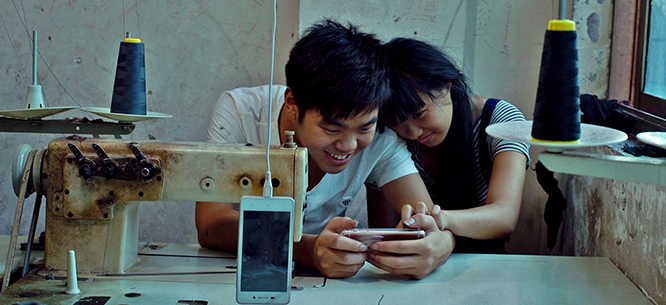
Filmed over five years in Zhili, a factory district in Huzhou, Zhejiang Province, Youth is an extraordinary, patient work. At nearly ten hours across three chapters, it reaffirms the slow-focused subjectivity that gave Wang a name and place at global industry locales like Cannes and the Venice Biennale. Each film—Spring, Hard Times, and Homecoming—is part of a triptych composed of shorter sequences where Wang follows individual or small groups of textile workers as they live and labor in peri-urban China. The workshops themselves appear stripped of personality, outfitted only with basic necessities and bare walls; it is the personalities of the workers that remain in high relief. Just as evocative are scenes in which the dialogue drops and the labor does the talking through the staccato thrums of sewing machines.
At its most vibrant, the cycle’s first installment Spring conjures a kind of realer-than-real reality TV seemingly cut off from—to paraphrase Jean-Luc Godard—the political act of editing. Wang’s camera captures extended shifts woven with intimate moments. Many of the workers are barely out of secondary school and their lives are closely supervised by their elders. In one scene, the bosses and a worker’s parents discuss their daughter’s possible pregnancy as she sits quietly; later she is pressured to have an abortion. Drab factory scenes are punctuated with fleeting moments of leisure outside the workplace: as Wang films his subjects goofing off on their phones, taking naps at internet cafes, or flirting listlessly, they remain apparently unbothered by the gaze of the camera, which merges, for a moment, with the watchful tech of the party-state.
Wang’s work had been, until recently, largely ignored by China’s authorities in spite of his coverage of politically sensitive topics; his 2010 film The Ditch notably puts a lens to Mao’s labor camps. With Youth, however, Wang has become another object in the crosshairs of the state censorship apparatus. This may have as much to do with geopolitics as with the work itself. As fear of China’s global supremacy has become a bipartisan obsession in Washington, the Communist Party has come to see Wang’s work through the eyes of a Western audience eager for dissident voices. Chinese social media services and websites have quietly erased references to his filmography, and journalists have been discouraged from covering his work. Western articles mentioning his Golden Lion nominations, as well as other favorable press, have been scrubbed behind the Great Firewall.
In public comments Wang has rejected the pretense (or accusation) that his films are a “political tool” with a broader agenda, anticommunist or otherwise. Even so, his projects circle China’s expansive people’s history. Youth, in particular, lays bare how China’s manufacturing settings have been subject to a Marxist paradox: a “withering away” and retreat of the Chinese state amid broad sociopolitical change.
As China has pivoted to international markets and free trade, thereby allowing industries to specialize in tech manufacturing, longstanding rural-urban inequalities have only increased. Facing diminished opportunities in agriculture and other “non-skilled,” non-industrial labor, rural workers have moved to cities—and back again. Journalists like Hsiao-Hung Pai, in his book Scattered Sand, have detailed these itinerant waves of migration, described as the largest in recent history. In Youth, Wang’s close-up view shows us how a working class once promised glory and liberation finds only precarity and the mere hope of perseverance.
Wang Bing hails from the latter of two generations of Chinese filmmakers who emerged alongside and following Deng Xiaoping’s economic reforms. In the 1980s, Deng’s so-called “socialism with Chinese characteristics” opened China up to global investment and created an increasingly stratified society. At the time, the Beijing Film Academy—the prestigious film school whose graduates include Zhang Yimou and Chen Kaige—set the standard for China’s film culture. Partly due to their pedigree, auteur voices like Zhang and Chen managed to evade and work around the overt censorship wielded by the party’s culture complex, presenting their subjects inventively and “getting away” with a self-endowed creative freedom.
Along with Wang Bing’s 2002 film Tie Xi Qu: West of the Tracks, later BFA alumnus Jia Zhangke’s 2004 landmark documentary work The World helped set in motion a generational tone shift in Chinese film, bookending the long transition from socialist realism to a tender social realism fit for the post-Y2K moment. The World follows workers as they relocate from the countryside for jobs at a Beijing theme park, which centers on a scaled model of the world and its landmarks. Though the film does not, at first watch, seem to make an overt political statement, the personal concerns of The World’s workers exist in tension with the socioeconomic possibilities—and political hypocrisies—of a more global China. Nonetheless, The World became Jia’s first film to be recognized and approved by the government’s cultural administration.
In certain ways, Wang’s work has always been more provocative than that of his peers. To that end, Wang’s public statements sometimes seem to affirm an iconoclast image, though they evoke frustration and resignation as much as dissidence. Last year, Wang was rumored to have been disappeared after he neglected to obtain the government’s “dragon seal” of approval, which allows the commercial release of films in China, before departing abroad to promote Homecoming. Wang, alive and well, later commented he has “never applied for the seal and never will. It is boring and meaningless.”
Wang’s interest in loss and labor was clear in West of the Tracks, which documented a post-millennium era of transformation. At nine hours—the length of a workday—the film follows characters as they are forced to detach from a receding way of life, all prior to a factory demolition in the Tiexi District of Shenyang. While West of the Tracks focuses on a more tight-knit community of older laborers with families, Youth shows how life has become more precarious for younger generations with only their wits to rely on.
China’s inequality in some ways resembles that of the rest of the industrializing world, and its atomizing effects are on display. The very first words uttered in Spring—an off-screen clamor of “I won!” after a workplace contest—sum up a zero-sum situation. Winning is a central theme in Spring, and it’s clear that China’s “996” work culture (9 a.m. to 9 p.m., six days a week) maintains a vice grip on the lives of a wide swath of China’s workforce. Youth’s post-adolescent workers hustle—for what, though, they are unsure.
After a shift in Spring, as two workers make their way home, one quips to another, “You’re a free man.” He is talking about the end of the workday, but it could be a statement about the film as a whole if punctuated with a question mark. The relationship between work and life remains open-ended in Youth. As scenes segue from leisure to labor with little in the way of intermission, living according to one’s needs becomes a way of life in itself.
Like those elsewhere in the Global South, Youth’s workers live and labor in suspense—they are only in Zhili temporarily, traveling for work, and then heading back to their hometowns, as captured in the film’s last installment, Homecoming. They are coming to understand what every young person seeks to discover and realize: what success means to them, uprooted from their parents’ past.
The days in which the language of collective liberation held pro forma status in China are long gone, replaced by what the Communist Party under Xi Jinping calls the “Chinese Dream”—the realization of China’s global preeminence as a wellspring for the success of the individual. Youth’s value as a documentary is in how it captures the reality of this people’s history writ small. The film’s young workers negotiate their lives and work at a historical moment defined by zero-sum estimations of possibility. Finding solace and solidarity with each other—they can hope—is worth more than a dream.
S.D. “Sabrì” Hodell is a writer, cultural worker, and teacher working in organized labor. He assist-instructs global history at the University of Connecticut.