Public Debilitation
Public Debilitation
Rebuilding government decision-making power requires not just removing veto points, but also addressing the outsized corporate power that gives the wealthy the best access to policymakers.
Why Nothing Works: Who Killed Progress—and How to Bring It Back
by Marc J. Dunkelman
PublicAffairs, 2025, 416 pp.
The Habitation Society: Creating Sustainable Prosperity
by Fred Block
Columbia University Press, 2025, 192 pp.
It is a hard moment to propose that Americans need to put more faith in their government institutions. The second Trump administration has destroyed federal programs people had counted on for decades and refused to abide by the rulings of other branches of government, all while working to enrich their allies and punish their enemies. Asking people to defend and empower the democratic institutions that put in place a would-be dictator is a tall order. Nevertheless, the authors of two new books seeking to chart a path for the left propose to do exactly that.
Marc J. Dunkelman’s Why Nothing Works and Fred Block’s The Habitation Society, both released in February, are each fundamentally concerned with what went so wrong in American politics that a demagogue was able to rise to power—and how we can reverse course. While ultimately offering very different proposals, they share the belief that a fundamental distrust of government is at the heart of our current crisis. Block writes of a “downward spiral of disillusionment with representative democracy that creates openings for demagogues.” Likewise, Dunkelman declares, “Absent a progressivism that works, what reformers get is a progressivism left vulnerable to demagoguery.” Rebuilding trust in government is core to both of their projects, but the degree to which their analyses diverge shows just how hard this project will be, and why Trump found such fertile ground in the first place. Together, however, they can help us start to find a way forward.
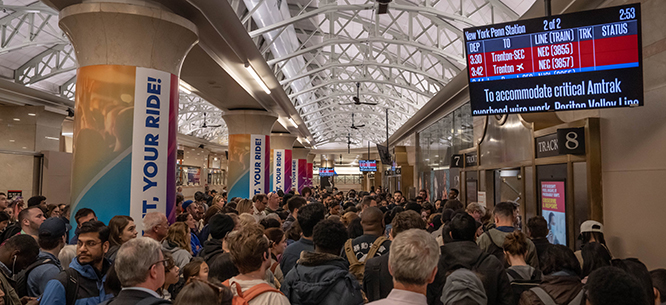
Dunkelman’s book begins with two things everybody loves to hate: Penn Station and Robert Moses. Penn Station is a confusing maze of underground tunnels not befitting the grandeur of the city to which it is a gateway (especially when compared to Grand Central). Moses is New York City’s most famous urban planner, made so by Robert Caro’s magisterial The Power Broker, which shows how Moses transformed the city’s landscape with utter disregard for the neighborhoods and people his plans affected.
For decades, politicians tried to transform Penn Station into something more than a confusing eyesore. Dunkelman began his project to understand how something everyone agreed needed to be done got so stuck. In the process, he found a legion of people secretly wishing for the return of a Moses-like figure. Why Nothing Works traces what happened between Moses’s time and our own to prevent such a figure from emerging.
Dunkelman structures his analysis around the theory that American politics has been defined by a war between Hamiltonian and Jeffersonian impulses. Hamiltonians believe a strong central government is an essential ingredient in progress and equity; Jeffersonians fear centralized authority and its potential for abuse. Dunkelman argues both elements have always existed in tension, with the pendulum swinging between the two sides. He is particularly interested in the latter half of the twentieth century, when Hamiltonian policies that originated earlier in the century ran into Jeffersonian objections. “Well-intentioned reformers” then fought for and won new laws and processes designed to give “voice” to the public, in the form of veto points for different constituencies. The success of this effort to push “centralized power down and out” ultimately led to the government’s inability to address critical and widely agreed upon problems. Frustration grew as problems festered, and more and more people came to view government as incompetent. Dunkelman sees this pattern repeat over and over: Memphis, Tennessee, ended up with a senseless, half-finished highway; New York City can’t build the housing it needs; it has already taken at least a decade to get Massachusetts access to the green energy its residents want because layers of veto points make it impossible to build a transmission line.
It is past time, Dunkelman argues, for the pendulum to swing back and progressives to overcome their “cultural aversion to power.” Of course, he says, it needs to swing back without losing the lessons of the Moses era. He calls for a “planning mechanism that both allows everyone to be heard . . . and empowers some centralized authority to make expeditious final determination.” In other words, while our decision-making systems should give people voice, they must claw back the veto points that late-twentieth-century reformers carefully established and reinvest power in the government itself.
Block asks a different question—not “why does nothing work?” but “why is democratic governance now experiencing the most intense challenges since the 1930s?” He believes the crux of the problem is not how people experience governance—as Dunkelman does—but rather how they understand the economy. He argues that we are still trying to govern society with the mental tools and institutions of an earlier industrial economy. The goal of his book is to help us see a new way of understanding the economy to allow us to better organize our society.
Like Dunkelman, Block sets up a central conflict to frame his analysis: habitation versus improvement (a dichotomy borrowed from Karl Polanyi). Habitation is defined by the residential arrangements that “sustain people,” whereas improvement is defined as the “drive to increase economic output.” Block believes this dichotomy, originally developed to describe the fight over enclosure in seventeenth-century England, which pitted subsistence farmers who counted on shared grazing spaces against large landowners who were trying to adopt more productive agricultural practices, still has purchase today. He defines twenty-first-century habitation work as including not only standard elements of a service economy, like education, child care, and healthcare, but also construction work, transportation, and energy. In contrast, improvement is focused on profits.
Applied to the twenty-first century, this dichotomy often seems too slippery to be useful. In fairness to Block, some of that slipperiness is his point. He believes that we now live in a “habitation economy” precisely because most improvement work is now in service of habitation, while many of today’s habitation industries are driven by profit-seeking innovation. The green energy sector, for example, lies at the intersection of habitation and improvement. Theoretically, Block writes, this should mean that the centuries-old conflict can be fully resolved, with increased economic output used in service of improved habitation. Instead, he argues, “the conflict is intensifying.”
To meet this challenge, Block believes we need to recover the work of Daniel Bell and other postindustrial thinkers from the 1960s and 1970s, who Block argues have been unfairly overshadowed by free-market neoliberals of the same era. The postindustrial thinkers believed that the economy was changing rapidly to center technological innovation, education, and specialization. All of this would require “a rethinking of inherited economic ideas” and a larger role for government in the economy. This is the world we live in now—one where “the most important forms of consumption are shared or collective,” Block writes. “What matters for our quality of life are not the items that we can pull off a shelf at a big-box retailer, but the quality of the environment, of the neighborhood, of the housing, of the health-care system, of the education system, of the energy infrastructure, of the transportation system, of the communication and information system, and so on.”
Because Hayek and Friedman won, however, we don’t have the appropriate governance structures for this economy. Instead of enlarging the role of government as these shifts occurred, we shrank it. We rely on the market to ensure access to high-quality habitation goods, but the forms of consumption that underlie habitation are not sensitive to individual market signals; most people can’t go find a different energy source if they don’t like the one on offer. Overriding market deference has thus failed to produce a safe, clean, and equitable economy.
Block concludes that it’s time for a “political and economic restructuring that gives all citizens greater control over their habitation.” He believes this can be best achieved through new forms of localized, deliberative bodies. He argues that this “decentralized participatory democracy” will provide people with “real opportunities to shape their own communities.” Only through this kind of deep, local engagement will we overcome generalized alienation from and distrust of government.
Block and Dunkelman represent two poles of what has become known as the abundance debate, so called because of Ezra Klein and Derek Thompson’s also recently released Abundance. Klein and Thompson call for a “liberalism that builds,” which they argue can be created only when we free ourselves from the regulatory shackles put in place by progressives in the 1970s who were horrified at the excesses of mid-twentieth-century governance. Dunkelman offers a nuanced analysis in support of this argument, laying the blame for our current moment squarely on “well-intentioned reformers” while also insisting that the appropriate response is not a blanket deregulatory agenda. Block, in contrast, places himself firmly in the tradition of those same reformers. Early on he declares the project of his book to be resurrecting the values of the New Left to make them “relevant to the lived experience of the third decade of the twenty-first century.” He thinks we need more voice, more participation, not less.
Given the ferocity of the abundance debate, it is useful to see how much Block and Dunkelman agree on what isn’t working for the American people: housing, energy infrastructure, and transportation. These are daily challenges for Americans; solving them, they say, is a prerequisite to restoring faith in democracy. But when it comes to whodunit, their answers come from different realities.
Block’s primary culprits are corporations. He argues that their economic and political dominance is upheld by a legal infrastructure premised on the false belief that they drive innovation and economic improvement. Five decades of policies giving these corporations free rein, limiting government spending, and suppressing wages left us with inadequate tax revenues, deficient public investment in infrastructure, and an increasingly financialized public sector—none of which are producing the quality of life we deserve and should demand.
In contrast, Dunkelman barely mentions corporate actors in his history of scarcity and government failure. He proudly declares that “nearly every element of the story can be explained without incorporating the (generally nettlesome) influence of conservatism.” In his history, it is progressive actors who gave us a political economy where nothing works by creating too many processes to check government power.
But just because you can tell a coherent story while leaving out half the history does not mean you should. In an argument that seems firmly stuck in the 1970s, Block writes, “It is the exception rather than the rule that decisions about infrastructure such as the location of highways, mass transit, high-speed rail lines, airports, or even parks are made through some kind of inclusive public deliberation.” Dunkelman shows that, in fact, almost all of these decisions are today subject to measures intended to create public oversight and input. For example, the Federal Highway Administration requires every state to develop policies and procedures that incorporate public hearings and involvement into federally funded highway projects. Infrastructure development has become an obstacle course of public vetoes. (Whether or not these mechanisms for public deliberation are effective is a subject of significant debate.) For his part, Dunkelman manages to tell the story of Rachel Carson and Ralph Nader as though their primary problem was with a government “captured, corrupted, and worse.” There is truth to this, but: captured by who? Corporate actors are central in Carson and Nader’s theory of government power, yet they barely feature in Dunkelman’s book.
Half-histories can help clarify the problems we face by giving due attention to the nuances involved in their creation. But they are a poor basis for finding policy solutions. Trying to solve the climate crisis, for example, solely by building in more layers of community participation reads as naive at best. “Whatever initiatives have been put into place by central governments,” Block writes, “are bound to move more quickly if and when people at the local level are actively engaged in reducing their community’s dependence on fossil fuels.” It is true that an actively engaged and supportive community could speed up these processes, but what about engaged communities with little interest in reducing dependence on fossil fuels? This is hardly hypothetical. Wind farms, for example, have faced lawsuits halting construction from community groups up and down the East Coast, mostly using processes intended to give communities voice.
On the other hand, at a moment when the people running our country are committed defenders of the fossil fuel industry and climate change deniers who have simply suspended the development of offshore wind altogether, it seems equally naive to suggest that empowering the government to make decisions more efficiently will solve the challenges before us. Dunkelman writes that his prescription will require progressives to take a “leap of faith” and accept that “public authority with fewer guardrails . . . will inevitably be utilized not only to serve progressive desires but to pursue conservative ends as well.” As strong as Dunkelman’s case for taking that risk is, it has gotten a lot harder to swallow in the time between when he presumably finished his final edits and his book hit store shelves.
Where does that leave us? We cannot simply rerun the New Left playbook of devolving power away from the federal government. Indeed, even Block repeatedly acknowledges the need for a federal backstop on local control; he hopes inequitable local impulses will be checked and quelled by robust federal funding and a court system committed to equity (if only). But nor can we ignore the excesses of power the New Left was responding to when it implemented reforms a half-century ago. We need the entire picture to understand how Americans became so skeptical of the federal government that we handed the reins to Trump.
In the end, these histories point to the insufficiency of understanding decision-making power as needing to be balanced between two poles—whether the poles are government and community, or community and corporations. There are many stakeholders who will try to influence every decision, and they don’t all have the same amount of power. Fossil fuel companies, fishermen, and homeowners who like their views all oppose the windmills—some on the basis of false information; environmentalists, labor unions, and future generations who want to slow the climate crisis all want the projects to move forward. The appropriate role of the government in a democratic society is to weigh all the inputs and act as the final decider. But we can’t expect people to have faith in the government to fulfill this vital role, much less empower it to do it better, if they do not believe the government has the ability or incentives to weigh the inputs of the full range of stakeholders.
To that end, any policy solutions to our current loss of faith in democratic institutions needs to account for the range of reasons those institutions stopped being able to sufficiently gather information and make decisions. Rebuilding government decision-making power is necessary to make things work, but that must mean more than simply removing veto points. We also must address outsized corporate power that gives the very wealthy the best access to government decision makers. And we must rebuild the organizations that provide countervailing power, including labor unions and a robust media ecosystem. To increase trust in government to make decisions that benefit us all, we need to rebuild its ability to make those decisions but also its ability to gather and weigh information by empowering the institutions that represent everyday Americans.
Suzanne Kahn is senior vice president of the Roosevelt Institute’s think tank. She holds a PhD in American history from Columbia University and is the author of Divorce, American Style: Fighting for Women’s Economic Citizenship in the Neoliberal Era.