City Limits
City Limits
Anne Hidalgo’s mayoralty illustrates the limits of local responses to national and international problems like housing and climate change. Without wider coordination, even the most successful mayor’s reach can only extend so far.
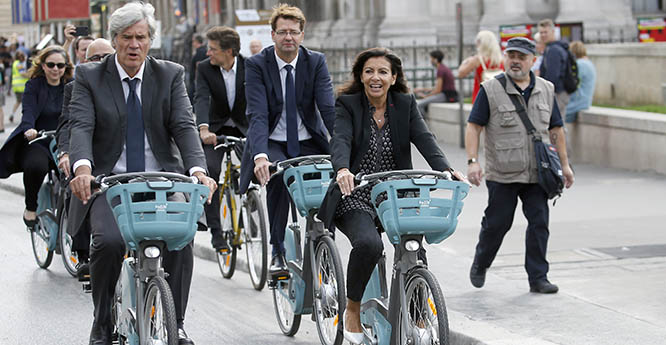
Since becoming mayor of Paris in 2014, Anne Hidalgo has transformed the city. Paris is greener, easier to cross on a bike, more pedestrian friendly. Large swaths of land that were once given over to cars are now open to people on foot, most notably the banks of the Seine. Parks have expanded, trees have been planted. Hidalgo has pushed forth a wide range of plans in order to fulfill her vision: new social homes, better healthcare, new monuments to women forgotten by history. Her push for social housing and against gentrification has won her praise around the world. This summer, the Seine opened up for public swimming, a decades-long project finally achieved.
This sense of constant—and often very delayed—change has earned Hidalgo regular grumbling from her Parisian constituents. Visible transformation around the city means construction sites wherever you go. Sidewalks are truncated, roads closed. Even projects that have wrapped up leave behind debris and uncollected material. Navigating this construction can often be confusing and frustrating, especially for those who move in a wheelchair or have to push a stroller. Regular debate surrounds the mayor. Her right-wing opponents often claim that she is ruining Paris; a campaign called Saccage Paris (Ransacked Paris) collects images of particularly ill-fated projects. The city’s debt, which has doubled under her tenure, has also raised hackles. But even the people who complain about Hidalgo have voted with their feet. The number of cyclists, helped by clean lanes and financial support for electric bikes and bicycle repairs, increased by 71 percent between 2019 and 2022.
Despite these positive changes, something is not quite right. Paris’s population has been decreasing by an increasing rate, now almost 1 percent a year. Classrooms have closed for a lack of students. Families are increasingly moving out. If Paris is so great, why are people leaving?
For New Yorkers looking at a Mamdani mayoralty, there’s a particular lesson in Paris. The city has indeed become cleaner, more agreeable, and easier to move around in. The city’s politics are far to the left of France’s; Paris has often stood against the anti-immigration sentiment that has taken hold of the state.
And yet Hidalgo’s success also shows the limit to what a single mayor can do to promote progressive policies. Because Paris is a city that is not well-connected to the rest of the region, it can only do so much. Hidalgo has been limited by her inability to work with the surrounding areas of Paris in order to achieve her goals on climate, housing, and inequality.
Crucially, because a Paris mayor’s reach can only extend so far, socialist policy has not been accompanied by affordability. And in becoming a place that fulfills many people’s dreams, it’s also become a place in which it’s much harder to actually live. Paris’s successes are possible because Paris is just a city. But because it’s just a city, any changes made there only affect a limited number of people.
In that sense, Hidalgo’s mayoralty illustrates the limits of local responses to national and international problems like housing and climate change. Without wider coordination, even the most successful mayor’s reach can only extend so far.
There are some crucial differences between Paris and New York. The city itself is small. While the larger metropolitan area has some 12.5 million people, the population of Paris itself hovers around 2 million, roughly the size of Philadelphia. Geographically, it’s about one-third the size of New York City. The mayor’s reach is further limited by the fact that the larger Paris area comprises 130 different municipalities of all political stripes. To the west of the city, many of them are more right-wing than Paris; the opposite is true the further one travels east. These towns rarely agree on anything, which is one of the reasons why Paris’s successes have been slow to extend outward.
Hidalgo promised in her first term to push for “Le Grand Paris,” a transformation of the city that would better integrate it with its suburbs, namely through a large subway infrastructure project. But while construction of the subway system is underway (though delayed), the larger ambitions of Le Grand Paris have dissipated. In addition to the fact that Paris’s suburbs are run by politicians of various political stripes, there are bureaucratic difficulties in coordinating the metropolitan area. All of this means that Hidalgo has struggled to build coalitions over crucial issues like housing and transportation.
A city is not only its beating center but its surroundings; the commuters who work in it, the transportation systems that link it, the national government that funds and fights with it. While Paris has changed, the fact that it has not really coordinated with nearby towns has in many ways increased inequality and in some cases even made things worse for those who live just outside the city. On three of Hidalgo’s main pillars—climate, housing, and social opportunity—her ability to make change has been limited by a lack of coordination.
Hidalgo has received widespread praise in the international press for climate-friendly policies, most notably closing the banks of the Seine to cars. She claimed that this would reduce pollution and give city residents access to the river. But doing so displaced car pollution. As commuters from outside the city were unable to drive along those roads, they redirected their routes through the suburbs instead. These changes have mainly moved pollution to the region’s poorer areas, according to a paper published in 2022. Richer residents in the city center get bikeable streets and clean air. Residents in the suburbs—often migrants or working-class families—get congested streets, polluted air, and a harder time moving around.
Another example is housing. While Hidalgo has pushed for more public housing in Paris, there’s little room for what she’s promised; the city is already one of the densest in the world. This means that any housing effort must include the suburbs. Hidalgo’s focus on social housing has borne fruit: Paris has increased the number of social housing units by around 40,000 since 2015. But that’s nothing near the 70,000 new homes a year needed in the Paris area to accommodate newcomers. And while rent is regulated in Paris, and Hidalgo has put in place measures against Airbnb, finding an apartment hasn’t become easier; in fact, there are fewer and fewer apartments available for rent, due to the number of short-term rentals and secondary homes. A lack of coordination among the Paris suburbs exacerbates the problem: each small town has its own rules for urban planning, meaning that each can pass the buck on new units.
A third example is child care. Hidalgo has sought to expand the number of day care spots available to children under three, which are subsidized by the national government. Access is a major problem; a report from 2023 described how in parts of the city, there was only one spot available for every five children. While Hidalgo has succeeded in increasing the number of spots, her success has been limited by the fact that child-care workers no longer can afford to live in Paris or have the time to commute there. As one day-care worker told Le Parisien, “If I had a home nearby, I would have stayed [in the city].”
After ten years with Hidalgo as mayor, Paris is transformed. But the limits of her accomplishments are visible in the very real limits of the city. Paris is surrounded by a loud and aggressive ring road, the périphérique, which cuts it off from the other towns around it. This road and its bureaucratic echoes have been a thorn in the side of Hidalgo’s mayoralty. Despite long-scale projects like the new subway system, integration between the city and the surrounding suburbs has been slow. Entrances to the city and large traffic crossroads have been a focus of Hidalgo’s, but the work is far from complete. The périphérique itself remains a reminder of how isolated Paris is.
On a cold October day, I took the subway to Porte Maillot, one of several city entrances designed in the nineteenth century at the northwest corner of Paris through which car commuters still enter and leave the city proper. It was a typical Paris fall morning, the kind of day where you feel like you’re wearing the sky like a hat. Two hundred years since their conception, the portes, or doors, still offer a clear demarcation of inside and outside. One of Hidalgo’s projects has been to transform these entrances, which are often mired in traffic and pollution. At Porte Maillot, the mayor has presided over the extension of a tramway and the regional rail and transformed the square itself to make it more pedestrian and bike friendly.
All of these transportation systems were visible as I left the subway. As part of Hidalgo’s Paris transformation, the mayor’s office had planted a kind of brush across the avenue and on traffic islands, which were being crisscrossed by long lines of cars. With the new tram and bike lanes, it was hard to know where to cross. Confused tourists with rolling suitcases wandered along the sidewalk. The light turned green; I took my chances. A woman in a car with both hands by the side of her lap looked at me and kept going through the stoplight. I made a sign at her; she ignored it. A passing truck driver, watching the scene, yelled, “People are crazy!” As I set foot on an island covered in grass and purple brush, an armored truck whizzed by, followed by a couple on a BMW scooter, the woman on the back holding crutches in her hand.
I decided to continue along the périphérique. Soon, however, I had to stop; the sidewalk was covered in construction. Different signs indicated different purposes. One made it seem as though a building was going up. Another indicated a possible bus depot. I crossed the street, then crossed back. As I continued along the highway, the sidewalk would sometimes disappear in this way, as if conquered by construction. Sometimes the périph was hidden by large grassy trenches that blocked the view and the noise. Sometimes it reemerged, and I could see the other side, lined with a graffitied wall.
I passed through the Promenade Bernard Lafay, a park built in 1990 that gave some vision of what a more integrated city would look like. It covered the highway, essentially getting rid of the separation between city and suburbs. The sound and sight were masked by tennis courts, dog walkers, soccer fields. But shortly thereafter, the highway revealed itself again: loud, aggressive, unpleasant. I passed by a housing unit where I had watched people kill rats with dry ice several years ago for a story. The burrows where they’d trapped the rats now seemed to be closed. From there, I walked along a rather sad-looking social housing building, where people, no doubt for lack of space, had left their possessions outside. A sign from the mayor’s office indicated that new trees would be planted in a small square of grass on the sidewalk, but the saplings seemed unwell. The path took me under a tunnel, where I tried to make out the graffiti. A lone cyclist inched by.
Paris is losing people every year, many to the nearby suburbs on the other side of the péripherique. The exodus has for a large part been led by families, according to Le Monde. Half of Parisian households now have only a single member. As a result, the area beyond the highway is more populous and younger than Paris proper.
By now, I had arrived at the Porte de Clichy, the end of my walk. Here, the difference on either side of the city gates was stark. In Paris, I saw the large new justice building, designed by Renzo Piano and opened in 2018; on the suburban side, a run-down hotel was being slowly renovated. The traffic on the Clichy side seemed chaotic and disorderly; on the Paris side, it funneled into clearly demarcated lines, surrounded by green space.
Whoever takes over Hidalgo’s job following the next municipal elections in March will have to contend with an irony central to her mayoralty: while she has improved life in Paris, there’s been a steady stream of inhabitants moving from the city center to the suburbs outside of it. Improving Paris will be limited as long as the larger suburban areas are not taken into account.
Not surprisingly, the périphérique itself has become the subject of debate in the lead-up to the elections. Some candidates wish to turn it into a park so that the cars remain but are hidden. Another wants to use it to host the marathon. But whatever they do, they’ll have to look beyond central Paris and better coordinate with the city’s variegated suburbs.
Of course, Paris’s issues are not identical to New York’s. Mamdani will have a much larger city to govern, geographically more varied and far more populous. But the broader issue of affordability doesn’t concern New York City alone, especially given the number of commuters to the city and the costs of housing in surrounding suburbs. To achieve anything, he’ll have to work with others.
There’s been an idea of cities as liberal bastions against the rising far right, but cities can’t really serve that function on their own. Mamdani will need to be a bridge and tunnel to the city’s neighbors. Otherwise, improving the city will just create another form of haves and have-nots, a utopian island so appealing that it leaves less fortunate residents no choice but to look on with envy.
Madeleine Schwartz is editor in chief of The Dial, a magazine of politics, literature, and ideas from around the world, and a member of Dissent’s editorial board. She lives in Paris.