Capital of the American Century
Capital of the American Century
Mike Wallace’s Gotham at War offers a guidebook to a half-vanished city, and brings to life the immense human drama that unfolded in New York during the Second World War.
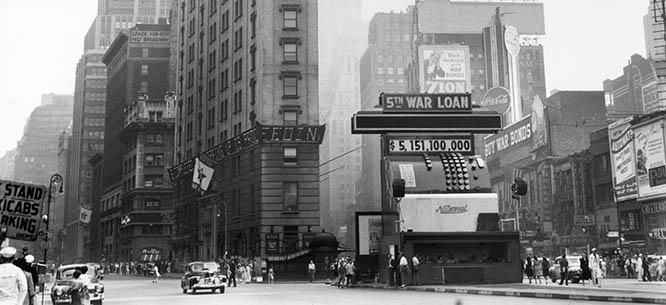
Gotham at War: A History of New York City from 1933 to 1945
by Mike Wallace
Oxford University Press, 2025, 976 pp.
Nearly three decades have passed since the historian Mike Wallace published Gotham: A History of New York City to 1898, cowritten with the late Edwin G. Burrows, to much renown. A second volume, Greater Gotham: A History of New York City from 1898 to 1919 (written by Wallace alone), followed in 2017. With the publication of the third and final installment in this panoramic history, Gotham at War: A History of New York City from 1933 to 1945, it is possible both to view the project as a whole and to look afresh at one of the most transformative eras in the history of New York, the United States, and the world.
There are roughly three faces of New York that run through Gotham at War. The first is the city as a connector—a “critical interlink,” Wallace writes, “between Europe and all of the Americas.” The second is New York as a generator, a source of ideas, forces, people, and products that shaped the country and the world. By playing these roles, New York affected the course of the Second World War; in turn, the war remade New York in ways both obvious and subtle.
A third New York appears early on in the narrative, though it is not until some 400 pages later that one of Gotham at War’s many characters describes it. This man, a young French sociologist recently installed at the New School, spends his days tutoring himself in the ethnology of Latin America at the 42nd Street branch of the New York Public Library. In the afternoons, when he is not writing, he walks the city. “What really amazed [Claude] Lévi-Strauss,” Wallace writes, “was that it seemed all of humanity’s cultures were on display in the astonishingly heterogeneous wartime city.” Lévi-Strauss had worried that industrial society would erase the local particularities of which culture was made. Yet in New York he found not an “ultramodern metropolis” but rather an “aggregation of villages”—a “vast collection,” Wallace writes, “of remnants and survivals from many continents and different eras, a palette of cultural sensibilities, an anthropologist’s dream.”
City as connector, city as generator, city of villages—these are the guises New York assumes not only in Gotham at War, but throughout the thousands of pages of the Gotham series. Inspired by the efflorescence of social history in the 1960s and 1970s, Wallace (with Burrows) originally set out to write a new narrative of all of American history, telling the story from the bottom up, with particular attention to the dynamics of capitalism and empire. Practical considerations eventually interceded, and the authors decided instead to refract their new history of the United States “through the prism of its preeminent city.” Like its pr...
Subscribe now to read the full article
Online OnlyFor just $19.95 a year, get access to new issues and decades' worth of archives on our site.
|
Print + OnlineFor $35 a year, get new issues delivered to your door and access to our full online archives.
|