
Amazon’s Robot Revolution
Amazon’s Robot Revolution
While the introduction of robotics at Amazon is still in an early phase, the technological transformation underway continues existing practices of work intensification, degradation, and displacement.
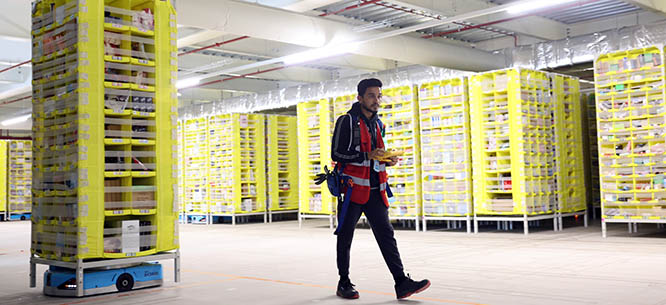
In 2018, Garfield Hylton became a picker at Amazon’s BHX4 warehouse in Coventry, a city in the English Midlands. BHX4 is the first stop in a product’s journey through Amazon’s distribution network. It’s a holding facility close to ports and railyards; workers there break down bulk shipments to be distributed to fulfillment centers, where orders are stored, picked, packed, and shipped. Hylton was one of about 2,000 workers at the warehouse, supplying tens of millions of items each year to the United Kingdom and Europe.
The facility, less than ten miles from two major highways and the Birmingham Airport, had once been an auto manufacturing plant—a Jaguar factory that closed in 2004, resulting in the loss of 2,000 union jobs. Amazon took over the factory site in 2016 with the promise of replacing many of those lost jobs. It ran twenty work stations across sixteen lines in two shifts. But since robots were introduced in 2020, Hylton told me, only three of the sixteen lines are worked by humans. “The other lines don’t exist; they have robots,” he says. “They now take all the high-yield boxes that used to go to the humans.”
The robots can handle twenty containers of goods, compared to a human’s twelve. “The robot sorter just needs to stand in one spot, flicking items onto the conveyor, and very little physical effort is required,” Hylton says, “while the poor humans are being driven into the ground processing low-yield boxes and doing more work.” In 2018, the facility processed 18 million items, but by 2024 it had surged to 24 million items. “All I know is that every day appears to be the run into Christmas peak.”
Much attention in recent years has focused on the negative effects of technologies like AI for consumers and white-collar workers. Amazon itself announced in October that it would lay off at least 14,000 corporate employees, and perhaps as many as 30,000—firings the company claimed were the result of investments in AI.
Less attention gets paid to warehouse workers like Hylton, who are experiencing arguably the most consequential impacts of new technology. He worries that his output will be measured against that of robots, whose pace would be certain to generate more muscle injuries in humans. More crucially, he worries that the robots will replace him entirely, an angst that echoes across time, back to the British weavers and textile workers who destroyed machine looms during the late eighteenth century in defiance of industrialists who used mechanization to dispossess artisans and drive them into misery.
The relationship between capital and labor leaves an imprint of managerial control on any new technology in the workplace. Workers’ fear at Amazon today isn’t about the robots themselves, but about the entirely human designs, uses, and impacts of a new technology in the hands of bosses—not, in other words, about the inexorable outcome of technological progress, but about the outcome of social conflict.
The word “automation” was coined by a vice president of production at the Ford Motor Company in 1947, one year after the largest strike wave in U.S. history. Automation didn’t refer to a specific technology, but rather to “an argument about the meaning of labor and its relation to technological change,” as historian Jason Resnikoff writes in his book Labor’s End: How the Promise of Automation Degraded Work. “Using the claim that ‘automation’ had fundamentally changed the nature of work, the company introduced a program of new job classifications according to which workers earned less and did more.” Today’s automation discourse speaks in terms of robotics and AI, but it’s simply the latest development in a long history of employers degrading labor under the cover of technological progress. “Workers sought security,” Resnikoff writes, while “management designed upheaval.”
The latest upheaval at Amazon comes from the rollout of advanced warehouses outfitted with robots. The company is overhauling older facilities to reduce their worker headcount. According to internal documents reviewed by the New York Times, Amazon plans to manage any negative publicity by talking up new jobs that will be created through the retrofitting of warehouses with robots and opportunities for retraining. This, too, is a common refrain in the history of management-imposed technological change. The United Packinghouse Workers of America, for example, allowed their employers to bring in power tools as part of a compromise that included job-training programs, but the plan backfired on the union when new skilled workers were hired into non-union jobs. Today, meatpacking still employs half a million workers, but they are largely non-union.
From 1980 to 2018, technological developments in the United States replaced more jobs than they generated—with the rate of job loss double that of 1940 to 1980. Workers without a college degree, in fields like the personal and health service occupations, have been hit particularly hard. Company executives, meanwhile, boast about a brave new world without complaining workers. “AI doesn’t go on strike,” as one CEO put it. “It doesn’t ask for a pay raise.”
Nowhere are the disruptions of automation more consequential than at Amazon, the second-largest private employer in the United States and the premier capitalist firm of the twenty-first century, with facilities on every continent except Antarctica and more than 1.5 million employees globally. Amazon is to global logistics what railroads and bridges were to nineteenth-century industrialists: the infrastructure that makes the entire economy move, from the virtual to the physical world. One click can set in motion a vast network of warehouses, cargo ships, planes, and delivery vans.
“Nobody else has the same incentive as Amazon to find the way to automate,” the economist Daron Acemoglu told the New York Times. “Once they work out how to do this profitably, it will spread to others, too,” he added, warning: “one of the biggest employers in the United States will become a net job destroyer, not a net job creator.” And as the robot revolution progresses, Amazon not only sets the pace but accelerates it for workers and industries around the world.
Amazon is also a key site of labor organizing across the globe. To take on a behemoth like Amazon is no less significant than the scrappy United Auto Workers taking on General Motors in 1936. Left unchecked, the company will continue to drive down standards and transform established work patterns among logistics, e-commerce, and retail giants seeking to imitate its business and employment practices.
While the introduction of robotics at Amazon is still in an early and uneven stage of development across and within facilities, the technological transformation underway suggests less a complete rupture from the past than a continuum with existing practices of work intensification, degradation, discipline, and displacement. Amazon has long subjected workers to a regime of algorithmically governed performance targets and surveillance, tracking their every move to wring out more productivity—a modern form of old-fashioned Taylorism. Now, the company is rapidly integrating robotics across its estimated 1,445 U.S. warehouses, with newer robots working alongside human workers.
Last June, the company announced that it had added 1 million robots to its warehouses, news meant to draw the eye of investors and chill workers fearing their possible replacement. In October, the New York Times reported the company was moving toward the goal of automating 75 percent of its operations—allowing them to sell more products without needing to hire an additional 600,000 workers to do the extra labor. It would also punt on plans to hire 160,000 people in the United States by 2027, saving it 30 cents on each item.
“We will need fewer people doing some of the jobs that are being done today, and more people doing other types of jobs,” Amazon CEO Andy Jassy said in a June announcement, attributing the changes to generative AI, not robotics. But the company’s largest employment cluster—about 390,000 workers, 43 percent of its distribution workforce—is at its U.S. fulfillment centers, where the threat is the parallel deployment of AI and robots.
Since acquiring the company Kiva Systems in 2012 for $775 million, Amazon has become the world’s largest manufacturer and operator of mobile robotics. Amazon today claims that AI has made its fleets of robots “smarter and more efficient,” and touts DeepFleet, an AI technology that coordinates the movement of robots across its fulfillment centers, cutting their travel time by 10 percent. Amazon transformed its inventory management at fulfillment centers when it began to use robotics to eliminate the need for workers to walk the length of football fields to move packages.
The majority of the robots Amazon deploys are called Hercules. Resembling a lawnmower or a Roomba vacuum, they navigate the warehouse by QR codes, constantly localizing and mapping their position. In the Guardian, logistics scholar Benjamin Y. Fong has argued that these warehouses, known as Amazon Robotics Sortable fulfillment centers, have seen a 25 percent reduction in their workforce in the last two years.
At the DBK4 delivery station in Maspeth, Queens, Amazon has introduced new conveyor belts, part of a technology called Auto Divert to Aisle (ADTA). The job previously required two roles: a picker who stood along a conveyor belt to pick packages and place them on racks, and a stower to sort the packages into bags designated for specific zip codes before they are ferried out in vans for delivery throughout New York City. “ADTA has changed all that,” Amazon worker Alvin Gaine wrote in Labor Notes. “Pickers are being replaced, with most being reassigned as stowers. An intricately designed belt now does their job, diverting the packages from the belt and into the aisles to be stowed.” But human workers are still indispensable. “For now, only the human touch can ensure the packages are lined up appropriately for the new belts,” wrote Gaine. “And the machine can only handle packages of smaller dimensions and weight without breaking down, so workers still have to deal with the larger packages.”
Without humans in the picker role, however, the packages are cascading into the belts faster than ever before, moving rapidly from the loading dock to belts to be sorted into bags by zip code, “causing downstream stowers to face growing piles of packages,” according to Gaine. The increase in productivity is labor-intensifying, not labor-saving: it comes from forcing workers to speed up. Fong notes that despite Amazon’s stupendous increases in volume, surging from 2 billion items in 2019 to 4.8 billion in 2021 and 6.3 billion in 2024, the company hasn’t increased its total labor force; in fact, it’s dipped, “a clear displacement given productivity increases.”
Amazon picker Paul Blundell says automation has made the work at delivery stations more repetitive, more stressful, and less social. “Despite Amazon’s PR claims of installing automation for worker safety and that the main effect would be to move workers into more interesting and high-skill jobs, the overall effect is to increase the danger from repetitive stress injuries and to degrade what little joy and social interaction remained in the job,” he says.
At the delivery station where Blundell worked in New Jersey, Amazon replaced one of four conveyor belts with the ADTA system in November 2022. It added two more lines in April 2023 to replace a pick-to-buffer system, a temporary holding area where workers shelved items going on the same delivery route instead of putting them in bags. “The role the automated system was designed to fill was eliminated,” he wrote to me over email, “but several machine-minder roles were created.” Nevertheless, “each automated pick-to-buffer system eliminates roughly five workers net.”
After Amazon installed the ADTA system, the number of packages Blundell’s delivery station was able to sort increased. “Before automation, 50,000 packages (a fairly typical daily package volume) could be sorted in a shift by 81 workers on average,” he told me. “After the full suite of automation was installed, that same 50,000 packages could be sorted by 65 workers on average.”
An Amazon worker in Louisiana, Meg Maloney, said that her delivery station has implemented an ADTA system like the one in DBK4 in Queens, in which an automated line dumps packages into stow bins for workers to pick up. At first, she and her coworkers feared that their jobs were in jeopardy because the new line eliminated puller jobs. Instead, their jobs were sped up. “They’re pushing out products faster than the line itself can even take,” Maloney says. “The pace that we set from the dock reverberates through the entire warehouse, and they’re constantly pushing people into the dock to induct faster and to get more product on the lines quicker.”
The automated system still gets overwhelmed. When it can’t read a package, a human being has to step in, requiring more workers to be hired to straighten packages and remove damaged ones that can’t be processed from the line. “We can figure out where something needs to go, even if something’s a little torn, or maybe the sticker is on the side instead of the front. The automated system can’t do that,” Maloney explains. “The automated line breaks constantly.”
Anne Fisk (a pseudonym) works at a cross-dock warehouse. These warehouses feed fulfillment centers in two or three states and employ about 2,000 to 3,000 workers. Fisk’s facility has robotic arms that pick up and stack totes, and another that works on pallets. But most of the work still requires human beings to fix the chaos created by managers. “When people talk about the efficiency of Amazon, I’m like, come into the warehouse, see how broken things are,” says Fisk. “Whenever they have upper management come in, they hide things in trailers and then leave them out there.” Another frequent problem is that the conveyor belts break down because they’re not calibrated for heavy boxes. “There’s not a single day when all the conveyor belts are constantly running. There’s always something that is broken. There is always something that is jerry-rigged to just work for now, until the next shift comes.”
Amazon has also spun the introduction of robotics as a way to address its worker injury rates, which are among the highest in the country. “The thing that they need to do to lead to less injuries,” however, Meg Maloney says, is to “put safety above speed.” The new systems have reduced injury rates, but because the job of puller involves many twisting and turning motions, they also create new hazards. When the stow bins overflow, the automated systems’ alarms begin blaring. Packages have to be put on a cart to be recirculated and sorted again, forcing stowers to stack boxes in the aisles, where it is easy to trip over them.
Workers at other fulfillment centers have launched campaigns under the banner of Amazon Hurts Workers to raise awareness of those who have become disabled working at the company. They’ve long argued that Amazon’s punishing quotas endanger them. In New York, California, and other states, Amazon workers have won legislative changes, mandating workplace ergonomics requirements and targeting unrealistic quotas.
Steve Hill (another pseudonym) works at a fulfillment center in California that employs about 4,000 workers alongside robots. “The hours are long,” he says. “Everybody hurts, and there is constant pressure to go faster.” The speedup relies on a mix of carrots and sticks. “However fast anybody is going, they will pick the bottom percentage of those and lean on them to go faster,” says Hill. “Do competitions between people to try to get them to go faster. You can get written up, disciplined, and people get fired for not keeping up.”
Hill calls Amazon a “repetitive-stress injury machine.” He earns about $20 an hour and says he and his coworkers put in about sixty hours a week to eke out a living. A typical day involves standing in place while robots bring them pods. “When they come to us, we put stuff in it, and they just come, come, come, keep coming”—sparing workers from walking the length of a football field to move items, but still keeping them in constant motion.
Catherine Blake (also a pseudonym) says Amazon is about to introduce new robots in the fulfillment center where she has worked for three years. Her description matches Proteus, Amazon’s first fully autonomous mobile robot. At the manual fulfillment center where she used to work, she was expected to walk ten to fifteen miles a shift. Now, she says, “I don’t walk that much, but the rate is higher”—about 250 items per hour. She worries that because the green robots can move around human workers, they pose safety concerns. “If you’re walking directly in front of it, it’s going to know you are there, but it can also have blind spots.”
Workers at her facility fear being replaced by the new robots more than they fear being injured. Managers, she says, have tried to reassure them, but Blake is unconvinced. She told me about her time working in a manual fulfillment center, where she handled heavy items like beds and big containers of dog food. The weight limit was supposed to be fifty pounds per box, but packages often exceeded that, forcing workers to go through them in an injury-prone process known as “slam.” Her takeaway? Managers’ assurances are hollow. They will lie through their teeth, even if it means breaking their own rules.
When the robots malfunction, reliability and maintenance engineers (RMEs) step in to fix the problem. Because these workers have potential disruptive power and leverage, Amazon has outsourced the work at its Kentucky air hub (an airport warehouse) to a contractor, Aerotek—even while boasting about productivity and “upskilling” workers for career advancement in response to automation. (The company is pursuing a similar outsourcing strategy through its Flex program, where, like Uber, it contracts drivers to make deliveries in their personal vehicles.) Outsourcing not only decreases Amazon’s vulnerability to disruptions in the flow of commodities caused by workers’ direct action; it’s also a way to undermine workplace organization through “fissured” employment, which shields Amazon from its employer responsibilities. According to workers, there are about 160 RMEs among the 3,600 employees at the Kentucky air hub. Some applied internally for the role and had backgrounds as electricians or mechanics, while others were hired as outside contractors. Earnings for those promoted from inside are about $34 an hour; contractors can earn as much as $40 and are given stock options.
Robots at the air hub include a robotic arm called Robin, which a worker there describes as an “octopus tentacle.” Compared to human workers’ rate of 1,000 packages in an eight-hour shift at a manual station, says an Amazon worker whom I’ll call Gregory Stone, each Robin can process upward of 1,000 packages per hour. They break down frequently and require regular maintenance. “But Amazon doesn’t really like them to shut down, so they don’t get worked on, and then they don’t work properly,” Stone explains. There are twenty-four manual stations at this particular facility that could presumably be replaced with Robin arms, except the robots, which lack human fingers, can’t pick up large items or very small ones; the arms are calibrated to pick up packages of about forty pounds.
The other robot is a Pegasus, which Stone says “looks like R2-D2” with a small conveyor belt on top. It replaces sorters by taking packages directly to a chute. But the crucial agents are the RME technicians, the human beings who attend to these robots. “They make sure that jams are cleared in a timely manner,” says Stone. “They make sure that the belts are fixed so that we can keep them going and keep packages running. If they just let something fail, or took their sweet time fixing something, then that’s going to cause a lot of pain.”
Stone thinks organizing a union with the Teamsters and winning a contract is the answer to this problem, calling bullshit on Amazon’s claims about automation making the facilities safer. “They don’t give a damn about safety. It’s about replacing people,” he says. “Because a robot doesn’t need a break, it doesn’t ask for vacation. It doesn’t need to take a leak. It just does its thing twenty-four hours a day, as long as it’s maintained.” And as long as workers don’t organize to stop them.
Amazon has used its algorithmic surveillance tools not only to monitor work, but to prevent organizing. Researcher Teke Wiggin of Northwestern University studied how the company’s algorithmic management was pivotal to its defeat of the 2021 union campaign in Bessemer, Alabama. Amazon monitored workers both to reward and to punish them. But the main use of digital-surveillance tools is to push workers to perform tasks faster. At Amazon’s Staten Island warehouse, where an independent union won a landmark 2022 election to represent 8,000 workers, posters adorned a bus stop organizing hub that read, “We are not machines. We are human beings.” These robotic warehouses have been key sites of worker organizing, from New York to North Carolina.
“Labor intensification must be understood as a problem that exists alongside the specter of technological unemployment,” sociologists Ellen Reese and Jason Struna wrote in The Cost of Free Shipping: Amazon in the Global Economy. “Amazon’s strategy seems to suggest movement toward a ‘lights-out’ world populated by a few technicians monitoring legions of autonomous machines.” In 2019, the director of Amazon’s Robotics Fulfillment Centers Network told Reuters, “the technology is at least 10 years away from fully automating the processing of a single order picked by a worker inside a warehouse.”
Six years into that decade, Amazon has already automated the processing of orders, opening its most advanced fulfillment center in Shreveport, Louisiana, just last year. But it still has people working alongside the robots. Amazon executives recently added another decade to the timeline, but the company is “confident in our ability to flatten Amazon’s hiring curve over the next ten years.”
For now, though, workers are still essential. Rather than lights-out facilities dotting the world, the reality is more mundane: robotics and AI are being used to speed up and deskill labor—to manage, displace, and control workers. Yet to be worked out is how large and widespread the looming job degradations of the logistics industry will be, as work is broken up into ever more discrete and menial tasks, and steady jobs are turned into cheaper contract labor in a fissured workplace made up of on-demand employment schemes.
Automation at Amazon is not just a process internal to the company. It is meant to pack a sensational punch with the broader public, amid headlines declaring the coming obsolescence of human labor. Nor is the fear of job displacement unwarranted. It looms especially large for workers with no union and no job security; degraded working conditions and poor pay are already here, not in the future. The execs pushing automation are more than happy to write the obituary of workers and their movements. But there is a long history of workers who were thought to have already been defeated, only to reappear as protagonists, face off against powerful bosses—and win. The scattered organizing efforts of workers across the globe will need to grow and come together to create a different future.
Luis Feliz Leon is a staff writer and organizer at Labor Notes. His writing has appeared in the Nation, In These Times, the American Prospect, and elsewhere.