A New Non-Aligned Movement?
A New Non-Aligned Movement?
The “middle powers” can band together to chart a third way between authoritarian superpowers in Washington and Beijing.
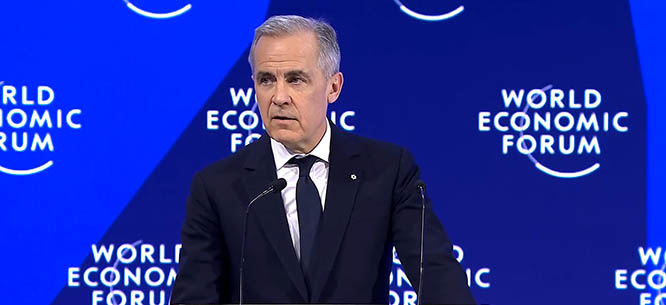
Who would have guessed that the eulogy for the liberal international order (LIO) would come in a Canadian accent? In January 2026, at the World Economic Forum’s annual gathering in Davos, Canadian Prime Minister Mark Carney—former governor of the Bank of Canada and the Bank of England, and the very model of a modern global elite—stood before an audience of his peers to perform a task few expected of a G7 leader: to deliver a dirge for the passing of the system that had done so much for the good and the great gathered there in the Alps. For decades, what Carney called the “pleasant fiction” of the LIO served as an operating system for global prosperity, predicated on the assumption that American hegemony would provide the public goods—open sea lanes, stable finance, and collective security—necessary for everyone to thrive. Carney’s speech was an admission that the promise and premise of the system was always partially false, hiding U.S. dominance under a veneer of multilateralism. It was also a blunt declaration that this cynical bargain no longer works given the present occupant of the White House’s open refusal to play along with the game. This is “not a transition,” he averred, but “a rupture.”
This rupture marks the definitive shift from a world of integrated markets and cosmopolitan ambition to one of visceral, resource-motivated competition and ethnonational division. We have entered an era where geopolitics is no longer a subtext of trade but its master. The return of Donald Trump to the White House acted as the coup de grâce, discarding any pretense of universal rules in favor of an incoherent “Donroe Doctrine”—a belligerent isolationism that treats allies as expendable and agreements as binding only for as long as they serve immediate American advantage. For the “Blob”—the self-appointed guardians of the foreign policy establishment in Washington—this gaze into the abyss is terrifying. For decades, they operated on the belief that the United States was (in Madeleine Albright’s infamous phrase) the “indispensable nation,” the benevolent underwriter of a world that was slowly but surely converging toward a single, Western-led model. That belief has been incinerated. The LIO is no longer a functioning system; it is a zombie order, kept upright only by the momentum of its own decaying institutions. The world is instead being cleaved into rival blocs: a Green Entente led by China and the “electrostates”—those nations committed to a green energy transition—and a revanchist Axis of Petrostates anchored by the United States, Russia, and the conservative monarchies of the Gulf.
U.S. competition with China is of course not new to the second Trump term. What looked to be shaping up in the Joe Biden administration, and likely would have continued if Kamala Harris had won the presidential election in 2024, was a contest between China and the United States over the most effective system for achieving the renewable energy transition. The signature legislative initiative of the Biden administration was the Inflation Reduction Act, which featured a vast package of subsidies for renewable energy development, and which was justified in large measure as a mechanism for competing effectively with China in green tech. (Europe wasn’t happy with the IRA, because they felt these subsidies were trade-distorting—but as I told former European Trade Commissioner Pascal Lamy in 2023, “You’re right that these are subsidies, but it’s an ecological imperative that everyone do subsidies to accelerate the transition.”) In other words, the form of Great Power competition envisioned by the Biden administration would have been over the political mechanism for transitioning away from fossil fuels and toward renewables. Much as the U.S.–Soviet Cold War was a debate over which system could more effectively produce economic development, the Biden-era form of the Sino-American Cold War was about which system could more effectively produce this transition.
With the return of Trump, however, the competition is now over not just means but ends. The global system is experiencing what might be called an “eco-metabolic divergence”—a divide between countries perpetuating fossil fuel energy systems and those pursuing green technology. The United States under Trump has effectively waved the white flag on the competition for green tech, with its national security strategy now declaring climate change a mere “ideology,” and rescinding subsidies for the very industries the Biden administration rightly believed would define the twenty-first century. Instead, the United States is betting its future on maintaining the greatest twentieth-century metabolic economy in the world—in part by beating into submission geopolitically wayward junior members of the Petrostate Axis such as Venezuela and Iran. With the United States effectively dropping out of the race, China now seems certain to dominate the twenty-first-century metabolic industries. Indeed, official state media in China has recently embraced the idea that China can serve as “a model for the global energy transition.”
Between China and the United States, Carney noted in his speech, are the “middle powers.” They now face the agonizing prospect of being pressured to choose between Beijing and Washington. Carney’s speech suggests that they are likely to want to pursue a policy of nonalignment, “prioritizing broad engagement” that will allow them to avoid making an absolute commitment to either of these overbearing superpowers. Maintaining such an equilibrium will not be easy. It will require pragmatically recognizing that, as Carney put it, “not every partner will share all of our values” —a point he underscored by noting that Canada had just concluded a “strategic partnership” with China, presumably to offset its longstanding relationship with a now-rogue United States.
To understand this new nonaligned movement, it’s helpful to revisit its ancestor.
The Ghost of Bandung
When historians speak of Cold War competition between the United States and the Soviet Union, it is rarely emphasized enough what was being competed over: the “hearts and minds” (as U.S. President Lyndon Johnson famously put it) of the emerging postcolonial world. In the early postwar years, as scores of countries freed themselves from the yoke of colonialism, the Soviets and the Americans put forth propositions to the Global South about the best way for these countries to achieve the lodestar of the era, namely economic development. Where the Soviets proposed communist central planning, the Americans proposed liberal modernization. But for many postcolonial countries, aligning too closely with either of the superpowers seemed like a formula for continued dependency on the metropolitan powers of the Global North. Instead, they sought to create a global movement of the nonaligned.
The Non-Aligned Movement traces its institutional origins to the Bandung Conference of 1955, a landmark gathering of African and Asian nations. Formally constituted in Belgrade in 1961, the NAM was spearheaded by five iconic postcolonial statesmen: Jawaharlal Nehru of India, Sukarno of Indonesia, Gamal Abdel Nasser of Egypt, Kwame Nkrumah of Ghana, and Josip Broz Tito of Yugoslavia. These leaders sought to articulate and advance a coherent ideological framework for postcolonial states navigating the polarizing geopolitical tensions of the Cold War, offering an alternative paradigm to the binary alignment pressures exerted by the two superpowers. Core to the NAM’s foundational objectives was the promotion of economic cooperation and mutual solidarity among newly independent nations, as a means of reducing structural dependency on either the United States or the Soviet Union. The movement’s aspirations encompassed demands for self-determination, sovereign equality, and recognition within the international order. As articulated by Tanzania’s Julius Nyerere, the concept of “positive neutrality” encapsulated the NAM’s ambition to preserve the agency of member states and prevent their territories from becoming sites of proxy contestation between the competing hegemonic blocs.
The eventual centerpiece of this ambition was the New International Economic Order (NIEO), launched in the 1970s. Sponsored by the G-77 at the United Nations, the NIEO was a radical project to restructure the world economy through international law. Its proponents, like Algerian President Houari Boumédiène and Mexican President Luis Echeverría, argued that the global financial architecture continued colonial patterns of extraction and exploitation. They demanded that the Global North share technology on concessionary terms with the Global South, called for resource cartels akin to OPEC for all manner of primary products, and asserted the right of developing states to nationalize their natural resources without Western interference. In short, the NIEO was an attempt to turn political independence into economic sovereignty, ensuring that the wealth of the Global South was used for the development of its own people rather than the enrichment of the Northern industrial core.
However, the NIEO’s dreams were crushed under the consolidation of neoliberalism in the 1980s. The debt crisis of that decade, triggered by rising U.S. interest rates, forced NAM members to turn to the IMF and World Bank for bailouts, which came tied to “structural adjustment” programs. Requirements to implement privatization, deregulation, and the opening of markets effectively neutralized the NAM’s collective bargaining power. By the time the Berlin Wall fell, the movement had lost its raison d’être; the world transitioned into a unipolar era where nonalignment was no longer possible. The LIO became the only game in town, and the former firebrands of Bandung were integrated into global supply chains to provide cheap labor and resources denominated in dollars. In the end, while the NAM attempted to transcend the Cold War, it ultimately became one of its chief victims.
The Hearts and Minds of the Middle Powers
Today’s emergent Cold War between the United States and China is also a contest for hearts and minds, but the prize has shifted from the periphery to the middle. A diverse group including both “established” rich countries like Canada, Australia, Japan, and Germany and “emerging” giants like India, Brazil, and Indonesia, the middle powers are the new swing states. The world finds itself in what the Carnegie Endowment’s Stewart Patrick calls a “middle power moment” because the United States has abdicated its traditional managerial role, and China is not yet ready, or perhaps not suited, to step up in Washington’s place. In Carney’s words, the middle powers therefore “must act together,” combining “to create a third path with impact.” The good news is that there are several crucial differences that afford today’s middle powers options that were unavailable to the G-77, that offer reasons to hope they may be more successful than the first version of the NAM in asserting their autonomy.
The new NAM echoes the first, yet it operates in a radically different context. The original NAM consisted mostly of former colonies that had fought to free themselves from their imperial overlords and were predisposed to form an alternative set of relationships. By contrast, many members of this new NAM are established powers who were quite content to be the junior partners of U.S. hegemony until Trump redirected American foreign policy in nakedly mercantilist and territorially expansionist directions. These middle powers are much wealthier than the postcolonial countries were seventy years ago. They have the resources and know-how to form “buyers’ clubs” and “plurilateral” trade blocs that can bypass traditional institutions. They also have the diplomatic and institutional capacity to form effective “minilateral” blocs capable of taking on specific regional or functional policy issues.
Likewise, the stakes of this new Cold War are very different. In the first Cold War, the struggle was over the relationship between state and society. Today, it is over the metabolic basis of the economy: whether to remain a petrostate or move toward becoming an electrostate. Many middle powers desperately want to become electrostates to ensure their own energy security and climate survival, but they are terrified of being wholly dependent on China. When the Biden administration was pushing the IRA, it looked as if one might not have to choose; with that effort now abandoned, the middle powers are trapped between a burnt planet (the path of the fossil-fuel-dependent petrostates) and an authoritarian cloud (the risk of dependence on the China-centered Green Entente).
Even countries eager to make the green transition worry about the prospect of subordination to a “Climate Leviathan” in Beijing. They fear that China’s dominance of green technology will eventually lead to a global system where the climate emergency is used as a pretext for a new form of command and control. In this scenario, the transition away from carbon would not lead to liberation, but to a set of planetary-scale surveillance and control mechanisms dictated by Beijing. The middle powers do not want to trade a thuggish U.S. petro-hegemony for a Chinese electro-hegemony in which political kowtowing is the price of survival. Instead, most of them would like to recuperate or rebuild some version of the now-defunct “rules-based” order.
At the same time, the imperatives of the transition are providing new leverage opportunities for some middle powers. Because of the mineral requirements of the electrostate model, countries well-endowed with critical minerals like lithium, cobalt, and rare earths can use these resources as a hedge, even if they are particularly vulnerable to U.S. smash-and-grab tactics, as seen in threats toward Greenland over minerals with high-tech applications or Venezuela over oil. As Miras Zhiyenbayev has noted, “Countries such as Kazakhstan, Indonesia, and Brazil use ‘multi-alignment’ policies to host multibloc investment, dilute monopolies, and promote rules-based trade—potentially protecting themselves from great-power coercion and promoting the diversification of critical minerals supply chains.” By controlling the metabolic inputs of the future, middle powers can hold strategic space between the superpowers and maximize their own national autonomy.
Then there is a massive contest over the computational stack—the interlocking layers of hardware, algorithms, cloud services, and user interfaces that constitute the new infrastructure of the global economy. The United States has tried to prevent Chinese firms like Huawei and ZTO from delivering 5G and to control chip manufacturing, forcing countries to choose between two technological spheres. But the new NAM is beginning to pursue a path of what Nathan Gardels calls “infrastructural non-alignment.” Vietnam, for instance, is pioneering a “third stack” in AI, rejecting an exclusive commitment to either the United States or China. In a more decentralized mode, Kenyan entrepreneurs are engaging in what geographers call “algorithmic suturing,” in which Chinese hardware and Western software are amalgamated to create local solutions for informal economies. This radical pragmatism allows these nations to treat superpowers as vendors rather than masters. As philosopher of technology Benjamin Bratton puts it, the multipolarization of geopolitics and the multipolarization of regional, national, and hemisphere techno-stacks are ultimately one and the same thing.
Last but not least, the present moment of rupture has enormous hard security ramifications for the new NAM. As the United States withdraws its security umbrella from Europe and Northeast Asia and treats its allies as exploitable, countries that used to complacently think of themselves as making up something called “the West” are effectively being pushed into a nonaligned posture. Middle powers will have to decide whether to continue procuring military hardware from the United States or instead to ramp up their own defense industries. They will also need to think hard about how to relieve their resource dependencies. This is especially true of the Europeans, who, having made what German Chancellor Friedrich Merz now admits was the “serious strategic mistake” of decommissioning their nuclear power plants, are intensely dependent on natural gas from an aggressive Russia and a hostile United States.
Despite these opportunities, the new NAM faces the same fundamental challenge that crippled the original movement: deep internal divisions. The middle powers are a heterogeneous group with interests that are rarely congruent. They are divided between oil producers and green transitioners, and between established rich powers and emergent Global South giants. Some, like Canada and Brazil, benefit from high energy prices as producers, while others, like India and Japan, are desperate for the transition to accelerate. As during the original NAM, building solidarity across these lines will be an ongoing problem.
These countries will also have to make strategic decisions in light of who seems to be winning the metabolic arms race between the United States and China. At present, it is China. While the United States has turned toward retro fuels and wild swings in trade policy, China is successfully positioning itself as the reliable partner while increasing its dominance over the industries of the twenty-first century. About 90 percent of new renewable energy projects are already cheaper than fossil fuel alternatives, and a flood of affordable electric vehicle models are rapidly displacing gas-guzzlers. Middle powers don’t want to be dependent on China, but neither do they want to bet on the wrong technological horse.
The stakes are ultimately much greater than the autonomy or sovereignty of the middle powers. If the petrostates prevail, the future involves runaway climate change or the hair-raising prospect of geoengineering gambles like solar radiation management. If the Green Entente wins, the world order will be organized under a new set of ideological and political dependencies favored by China. The new NAM represents a desperate, collective attempt to chart a third way that preserves autonomy in a world where the old rules have been torched. Whether it will succeed depends on the middle powers’ ability to build a resilient, cooperative world from the fractured elements of the old one, before they are consumed by the giants. Carney’s eulogy at Davos was more than a lament for the past; it was a clarion call for a future order belonging to those who can navigate the metabolic and technological abyss without falling in.
Nils Gilman is a historian and senior advisor to the Berggruen Institute. He is the author, with Jonathan S. Blake, of Children of a Modest Star: Planetary Thinking for an Age of Crises (Stanford, 2024).