Trump’s War
Trump’s War
The fact that the war in Iran has proven so shocking to both Trump’s base and the broader commentariat reflects how distorted the popular view of Trump and MAGA has become.
The onset of the U.S.–Israeli war against Iran on February 28 was startling, coming less than four days after a State of the Union speech in which Donald Trump barely mentioned Iran. In the longer view, it should not have been a surprise. War with Iran was a predictable culmination of Trump’s foreign policy, stretching back to his 2018 decision to terminate the JCPOA, the Obama-era nuclear deal with which Tehran had remained in compliance. Trump nearly stumbled into a war with Iran at the end of his first term with the reckless decision in January 2020 to assassinate military commander Qasem Soleimani. After Tehran decided to grit its teeth and wait out the final year of Trump’s term with limited retaliation, memories of the near-miss faded with the onset of COVID-19. When Trump won in 2024, one of my first thoughts was that we would probably see a war with Iran in his second term, although I hardly expected the total nonchalance with which he waltzed into it.
The fact that Trump’s war has proven so shocking to both his MAGA base and the broader commentariat reflects how distorted the popular view of Trump and his movement has become. It also reflects broader distortions in how the United States has come to narrate its own foreign policy failures over the last quarter-century. Those hoping to end the current U.S.–Israeli war of aggression and avoid future repeats would do well to correct both mistakes.
Let’s begin with our dear leader. While he might be the inaugural winner of the FIFA Peace Prize and the secondhand recipient of María Corina Machado’s Nobel Peace Prize, there has never been any evidence that Trump is a noninterventionist, much less a “man of peace.” It used to be well known that Trump supported the Iraq War during the run-up to the 2003 invasion. In a preview of the approach that would work so well for him in so many domains, Trump simply repeated the lie that he had been against the war until exhausted opponents gave up on contesting it.
Trump’s first term was a hawkish one by most measures, a fact that his apologists blamed on his “establishment” advisors. While there is no doubt that figures like James Mattis, H.R. McMaster, and John Kelly were hawks, the evidence is that they served more to restrain than to embolden Trump. Mattis, who fell out with the Obama administration over Iran, was still more dovish than Trump on the issue and unsuccessfully pushed Trump to remain in the nuclear deal. Likewise, the Soleimani assassination was Trump’s own doing: reportedly, it was the most bellicose of several choices that military planners laid out under the misapprehension that this framing would steer the president toward the Goldilocks middle option. On Venezuela, Trump had been floating the idea of military action since 2017, and he had to be talked out of it by the adults in the room during his first term.
Trump fans who concede that he is not a principled noninterventionist instead often cast him as a realist. Yet while there is some ambiguity about what qualifies as realism, and some points of convergence between realists and Trump—like skepticism about support for Ukraine—the large majority of actual realists have been sharply critical of Trump throughout his years in office. This is because they have recognized, correctly, that although his administrations are good at producing realist-sounding verbiage that generates media coverage—think the 2025 Riyadh speech or the recent National Security Strategy—these declarations are never matched by actual follow-through. Ultimately, there is something faintly comic about the various attempts to jury-rig a coherent ideology for Trump, which the boss always undercuts within weeks. Remember, all of two months ago, when the much-hyped “Donroe Doctrine” signaled that we were detaching from the Middle East to focus on the Western Hemisphere?
Trump’s foreign policy stems less from any coherent ideology than from a few psychological peculiarities. First is an intensely personalist approach. For instance, he seems to have torpedoed the Iran nuclear deal less in response to Israeli and neocon pressure than out of pure personal animus against Obama, who had mocked him at a dinner a few years earlier. Second is a fetish for extractive resources like oil, one which often exceeds the material value of such resources. Seizing Venezuela’s oil was a good way of selling Trump on intervention in the country (as the likes of John Bolton had already realized in his first term), but the actual U.S. oil industry was much less enthusiastic. Third, and above all else, is an obsession with perceptions of dominance, toughness, and masculinity. Taken together, these traits make him easy to manipulate. Thus in 2019, after Trump pulled troops out of Syria charged with protecting Kurdish allies (sounds too humanitarian), his advisors convinced him to reverse course by changing the avowed mission to “keeping the oil” (sounds properly tough and macho).
Misreadings of Trump lead to transitive misreadings of his henchmen, with some commentators assuming that anyone who is sufficiently MAGA must be a foreign policy dove. Stephen Miller, for instance, who is mostly known for his hatred of immigrants, has learned to denounce Trump opponents for being “warmongering neocons,” but he is also a lifelong hawk. Miller got his start as a young activist accusing critics of the Iraq and Afghanistan wars of being “treasonous” and aligned with “terrorists,” and he was reportedly one of the major drivers of the Venezuela attack alongside Marco Rubio. It turns out that wanting to inflict violence on brown people at home is not inconsistent with wanting to do so abroad.
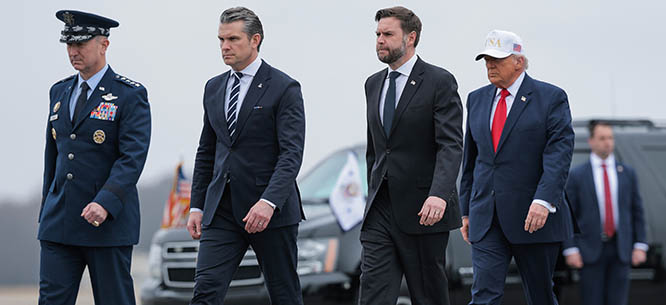
Similarly, the media has ascribed “isolationist views” to Pete Hegseth because he is so obviously Trumpy (TV personality, sexual assault allegations, hates wokeness). The main evidence is his declaration that he stopped being a “neocon” around 2018 (at precisely the moment that being identified as a neocon had become a major liability in right-wing politics). Whether or not he is a neocon, however, there is no substantive evidence that he has ever been anything other than a bloodthirsty hawk. I first became aware of Hegseth in the late Bush years when he was the public face of Vets for Freedom, a right-wing astroturf group focused on pro–Iraq War propaganda at a time when public support for the war was collapsing. As he moved into TV in the 2010s, he transitioned from support for the Iraq War in particular to support for war crimes in general, crusading for clemency for the likes of Eddie Gallagher, who was turned in by his fellow Navy SEALs for the alleged recreational murder of Iraqi civilians. In any case, Hegseth’s actual record did not prevent him from becoming a cause célèbre for the self-proclaimed antiwar right. When his nomination was floundering in the Senate, it was a pressure campaign from Steve Bannon and Charlie Kirk that helped push him over the finish line.
Even Tulsi Gabbard, with her long record as a critic of the Iraq and Afghanistan Wars, is far from an across-the-board dove. Her career-long alarmism about “radical Islamic terrorism”—a phrase she criticized Obama for not using—made her suspicious of “regime-change wars” aimed at democratizing Muslim countries, but it kept her firmly committed to the “kinetic” aspects of the war on terror. She was ironclad in her support for the drone war under both Obama and Trump, and likewise in support of the Israeli razing of Gaza. A persistent legend holds that she opposed U.S. intervention in Syria; in fact, she opposed only U.S. intervention against Bashar al-Assad, and excoriated Obama for not intervening more forcefully in support of him. While the current war clearly involves some cognitive dissonance for a figure who used to sell “No War With Iran” T-shirts on her website, Gabbard’s longstanding preference for the drones-and-bombers approach over the hearts-and-minds one is not so far removed from that of her current boss.
Antiwar MAGA has never had a hard time finding wicked advisors to blame for Trump’s failures to live up to their visions of him. In the first term, the likes of Mike Pompeo and John Bolton served as scapegoats; this time around, Marco Rubio seems poised to fill the role. But the record of Trump’s first term provided little reason for optimism that an unconstrained Trump surrounded by “his people” would be less bellicose, and his second term thus far has removed all doubt.
Stepping back from individual personalities, are there any broader conclusions to draw from this sorry state of affairs? Why did the commentariat find it so hard to see what was coming? Much of it has to do with how the United States has remembered, or misremembered, its foreign policy in recent decades, especially the Iraq War.
The fact that the likes of Hegseth and Miller are comfortable sneering at “neocons” is indicative of one feature of this cultural memory: the isolation of the neoconservatives as sole perpetrators of U.S. foreign policy malfeasance.
The neocons have a genuinely pernicious record (which I among many others have written about elsewhere). They were the intellectual vanguard laying the groundwork for the Iraq War; in the early days when the war was treated as a success, they were happy to claim credit for it, and by that same token deserve blame for its injustice and its failure. But in a war that enjoyed 90 percent support among Republicans at its outset, it is misleading to treat a group of intellectuals and bureaucrats that could fit into a basketball arena as the entirety of the right-wing war party. As important as the neocons were in shaping the discourse, the truly consequential decision-makers were not neocons at all—in particular the triumvirate of George W. Bush, Dick Cheney, and Donald Rumsfeld, along with liberal leaders like Hillary Clinton and Joe Biden who chose to go along with their war. The current MAGA cult of hatred toward neocons has less to do with a proper reckoning with the Iraq War than with two other motives: the need to discredit a group that would comprise a large portion of Trump critics on the right, and a desire to pretend that American militarism is a foreign transplant grafted on by a few Jewish intellectuals.
As MAGA has focalized blame on the neocons, it has also tended to identify neoconservatism with Wilsonian democracy promotion. America’s mistake, on this reading, was its naive and humanitarian desire to bring civilization to the Middle East. But neoconservatism has never been exclusively wedded to dreams of universal democracy. The most important document of first-generation neoconservative foreign policy principles, Jeane Kirkpatrick’s “Dictatorships and Double Standards,” was a call to defend friendly “authoritarian” governments of the right against potentially “totalitarian” movements of the left, democratic or not. Well into the twenty-first century, neocons have remained divided on the extent to which the defense of democracy supersedes other priorities, like the defense of Israel—a division that helps explain the split between pro- and anti-Trump camps within the movement.
More importantly, identifying the Iraq War with democracy promotion pure and simple misunderstands the war itself. Those of us old enough to remember the run-up to war will understand that benevolence was not the dominant mood: people were angry and frightened after 9/11, and they wanted revenge. “Something much larger than [Osama] bin Laden needed decapitation,” William F. Buckley explained, glossing the views of the so-called “superhawks” of the Claremont Institute (subsequently to become the most prominent group of MAGA intellectuals). As the original war rationale based on WMDs collapsed, the Bush administration fell back on more idealistic justifications. Bush’s 2005 second inaugural speech, two years after the initial push for war, marked the zenith of this trend. But the reason that people like Trump and Miller supported the war is that its original impetus was one that appealed to people like Trump and Miller. And the dominant mood on the right in 2003 was not far off from the one in 2026.
This misremembering of the Iraq War set the terms of subsequent MAGA foreign policy. If Iraq had been an exercise in misguided democratic idealism, avoiding subsequent Iraqs meant renouncing such idealism. This had the effect of setting the critical bar far too low: the only kinds of interventions ruled out were troop-heavy occupations justified with humanitarian rhetoric. What was absent was the basic noninterventionist insight that discrete actions, even when limited and apparently successful in the short term, might have perverse consequences in the long run.
Until February, Trump had avoided full-scale wars. But his presidencies have seen a steady ratcheting up of aggressive actions that won praise from the MAGA influencer class for clearing the low bar of not being Iraq. The fact that MAGA came to remember the Soleimani assassination as a Trumpian masterstroke helped lay the groundwork for the current war. So did the largely positive response to last summer’s bombing of Iran (“President Trump acted with prudence and decisiveness,” according to Charlie Kirk) and this winter’s abduction of Nicolás Maduro (“a resounding victory and one of the most brilliant military operations in American history,” according to Matt Walsh). By all accounts, it was this run of instant-gratification “wins” that convinced Trump to gamble on the current war.
Now the movement is looking for scapegoats. Along with a fixation on neocons—somewhat beside the point in an administration containing no self-proclaimed neocons—goes a fixation on Israel. The Israel angle is important but not sufficient on its own to explain this war. Israel and its American allies have clearly pushed hard to drag the United States into war with Iran—much more so than with Iraq, where Israel and groups like AIPAC broadly supported the war but never led the drive for it. This influence has been real and malign, but the problem is that Israel and its American allies have been pushing this war on every president since George W. Bush. The relevant question for MAGA is why this campaign, after two decades of failure, finally worked on Trump—and why their man of peace was the one to launch the war that even Bush was smart enough to avoid.
Though I would not endorse the contrarian journalist Michael Tracey’s entire roster of takes, he is clearly right about “the problem with Tucker.” The melodramatic conspiracizing from figures like Tucker Carlson and Steve Bannon about Benjamin Netanyahu casting a nefarious spell over Trump results from a simple failure to come to terms with the fact that their hero started this war because he wanted to start this war. (Why? Because he was frustrated about being stymied domestically, because he wanted another quick-gratification show of dominance, because he likes blowing shit up. He contains multitudes!) It would be comforting to share Carlson’s faith that the American killing of a hundred-plus schoolgirls in Minab must have been the result of perfidious Israeli intelligence because “America doesn’t do stuff like that.” Sadly, our country did not require any lessons from Netanyahu to learn how to kill innocents. The Iran war belongs to Mark Levin, Ben Shapiro, and the rest of its actual supporters. But it also belongs to Carlson, Bannon, and the rest of its MAGA opponents, who worked to propagate a set of transparently false claims about who Trump was and what his return to power would mean.
What does any of this mean for the left? The immediate priority is to stop the war, and in the short term there is no reason to refuse alliances that help to bring that about. But in the longer term, it is worth thinking hard about our own rhetorical and analytical strategies. In a world where the Democrats are so uninspiring—or worse, as in Gaza—it is tempting to exaggerate the horseshoe theory possibilities with elements of the right. On this view, even if these formations never fully come to fruition, it’s useful to emphasize the possibility that liberals will be outflanked by the right on populist economics or on noninterventionist foreign policy, if only to put pressure on liberals to get better.
The danger is that you can get your own side confused about the actual stakes of political conflict. I have always been skeptical that MAGA would lead anywhere genuinely populist on economics, and last year’s Big Beautiful Bill served as ample confirmation of that skepticism. The Iran war similarly undercuts any hope that rote right-wing denunciations of “endless war” will actually lead us away from endless war. It is nice to imagine a world in which the two parties compete over who can be more pro-worker and more antiwar. But we live in a much more depressing world than that. We should not delude ourselves about the virtues of actually existing liberalism, but neither should we delude ourselves about the alternatives on offer.
Daniel Luban teaches political science at Columbia.