ICE on Ice
ICE on Ice
I am never the first person to arrive at an ICE raid. I am never the last person to leave.
We’ve all seen the video of the agent slipping on the icy side street. We’ve saved every angle, dissected every frame, the way he brings his legs together at the moment of truth as though concentrating his body mass will summon the steadiness he so desperately desires. We’ve all made the joke about ice on ICE violence. We remix it. A coworker is delighted when I clock in for my shift because she’s been waiting all day to show me the version where a self-satisfied Garfield watches from a distance, smug after having executed his prank with the tactical precision of a guerrilla warrior. We share images of unmarked vehicles rocking back and forth in unplowed snow, and we all say the same thing: do you have any idea how much a Minnesotan has to hate your guts not to get out of their car and dig you out? A month before Renee Good’s murder, I got stuck on the side street where I’d parked during an Anti-War Committee (AWC) meeting, and a woman who’d been watching from her window donned her long johns, grabbed her shovel, and got to work.
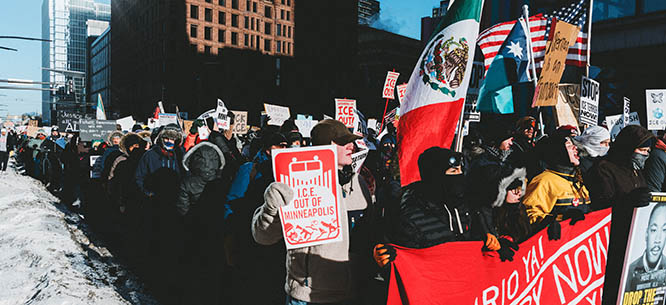
I think about her during school pick-up when I’m talking to the mothers in bright orange vests who wear whistles for necklaces. We circle the parking lot, stand by the buses, and keep our blue fingers glued to our rapid response chats in case an ICE agent tries to exploit the few unprotected feet separating a child from their transportation home. A woman tells me that her son is now fearful of every man in a uniform. “I’m explaining to him, these guys aren’t the same as the police, you know? They may look similar, but he needs to understand they’re completely different agencies.”
“How so?”
We talk about the summer of 2020, the opening at the bottom of the discursive funnel into which every conversation inevitably drops. We talk about what the word “criminal” means to us. We talk about what we imagine when we hear the word “safety.” I tell her about the Minneapolis police officers who were trained by Israeli police and military officials, about the ICE officials whom the Anti-Defamation League flew to Israel for its counter-terrorism seminar. I wonder aloud whether a few more cameras and years of training would have really stopped a former National Guard soldier from shooting Good in the head. This is a golden opportunity for the Minneapolis Police Department to convince us that at least they aren’t as bad as those guys, but we must keep our memories long and our analyses structured by the lives and executions of Jamar Clark, Philando Castile, George Floyd, Daunte Wright, Leneal Frazier, Amir Locke, Ricky Cobb II, and Kingsley Bimpong. When my new friend expresses her fear of getting arrested, I offer her advice about avoiding bruising around her wrists. We smile and wave at the children exiting the school because we don’t want to be another group of unfamiliar adults rattling fear into their tiny ribcages. We show each other our favorite iterations of the wipeout seen around the world.
Days later, I eat shit on Lake Street as I’m sprinting through the Powderhorn protest in my marshal vest to block the next intersection. I hope that none of the undercover cops in the crowd catch it on video. Do they have their own networks of Signal chats through which they disseminate evidence that we rugged Northerners do, on occasion, face-plant in the ice, too?
Last summer, a group of plainclothes federal agents brutalized poet and activist Isavela Lopez during an attempted ICE raid a few blocks down the street. The Minnesota U.S. Attorney’s Office charged her with a felony. A number of staffers at the office resigned after Jonathan Ross murdered Renee Good, but there was no such exodus when they announced Lopez’s charges in June. I’m grateful for the people across the world lending our city their attention today, and I wish I lived in a country where a story like Lopez’s could inspire the outrage and mass mobilization it took a federal occupation to ignite.
A friend in New York sends a missive from a solidarity protest complaining that the chanters aren’t staying on message. “We’re all looking to you guys,” she says. “You’re our only hope!” It isn’t true, of course, as networks of organized neighbors in Los Angeles and Chicago continue resisting federal abduction programs and mourning Keith Porter Jr. and Silverio Villegas González, but I show the message to the friends I’m with at the Palestine rally outside the Walker. “We’re Brooklyn’s only hope! We’re the Obi-Wan Kenobi of Bushwick, New York!”
In Minneapolis, organizers rarely have to fret about ideological incoherence because we all know each other. We marshal each other’s protests. We share the same sound equipment, the same screen printing materials, the same twenty dollars we Venmo back and forth ad infinitum. This is a small city. Everyone either knows someone who’s been kidnapped or knows someone who is grieving. Our size is the reason why Donald Trump’s deployment of at least 3,000 federal agents has been so devastating, but it is also one of the reasons why we got organized so quickly. We need to work in coalitions because there aren’t enough of us to operate effective campaigns alone. As an antiwar organizer activated by the student movement for Palestine and shepherded into city-scale mobilization by the AWC, I work alongside the Minnesota Immigrant Rights Action Committee (MIRAC) because we understand that our struggles are interconnected. Some of the articles about us characterize our resistance as spontaneous, but MIRAC was organizing to keep our neighbors safe long before an agent of the state executed Good and long before an agent of the state attacked Lopez then blamed her for the bruises he’d beaten into her.
We know that when the U.S. government destabilizes states outside of the imperial core, it consequently displaces the people of those states and criminalizes them when they migrate here. We all see our government using our tax dollars to refine its violent strategies of dehumanization, both internally through the American prison system and externally by intervening in countries like Venezuela. The speeches at the rallies I marshal invite me to think about how I can calibrate my work with the AWC to function in harmony with MIRAC’s campaign for legalization for all, the Twin Cities Coalition for Justice’s campaign for community control of the police, and the Climate Justice Committee’s campaign to get Northern Iron out of St. Paul’s East Side.
Operation Metro Surge has transformed Tim Walz into America’s dad again. Those of us who aren’t attending our first rodeo refuse to adopt him. We wonder if he thinks we’re waiting with bated breath to read his next strongly worded letter. As the president bullies Governor Walz, Mayor Jacob Frey, and Attorney General Keith Ellison with Department of Justice probes, sensationalist fraud stories, and allegations of the kind of radicalism that would earn them our respect, our elected officials go on publicity tours and maintain their distance from the street protests and rapid-response networks through which their constituents are resisting the federal invasion.
Walz chairs the State Board of Investment (SBI), which pours millions from public workers’ pension funds into corporations that sell ICE the technology it uses to track down and abduct those very workers. Fifty-four million goes to Lockheed Martin, manufacturer of both the patrol aircraft the Department of Homeland Security uses to militarize the U.S.-Mexico border and the warplanes and Hellfire missiles the Israeli military uses to decimate schools and murder children. Twenty-two million goes to L3Harris, whose cell-site simulators ICE uses to track undocumented immigrants and whose weapons system components enable Boeing’s Joint Direct Attack Munition “smart” bombs to track and execute Palestinians. Fifty-five million goes to Palantir, whose AI platforms help determine which Palestinians the Israeli military snipes, which majority-Black neighborhoods U.S. law enforcement targets for “pre-crime,” and which Minnesotans masked men abduct and threaten with torture in an El Salvadoran concentration camp. The SBI has either canceled or made virtual the last three of its quarterly public meetings.
When I got arrested for sitting in the SBI’s long-neglected offices to demand the board take the preliminary steps to divestment and recommit to hearing public comment, MIRAC organizers chanted outside the jail in the freezing rain until we’d been freed and fed. When several of the MIRAC members who’d greeted me upon my release sat in Frey’s office demanding that he implement their proposed revisions to our separation ordinance in order to make Minneapolis a true sanctuary city, I hollered up at them from the plaza below. When Frey issued an executive order in December prohibiting law enforcement from staging immigration operations on city parking lots, ramps, and garages, the mainstream coverage omitted the organizers who’d spent the night in jail to force his hand. Likewise, when the city council unanimously passed a revised separation ordinance to codify Frey’s order while preventing him from using city resources to aid federal immigration enforcement, there were scarcely any mentions of the community members and organizers who had drafted those demands in the first place.
I get lunch with the folks from the food drive after we’ve finished delivering the two-and-a-half truckloads of non-perishables that the university students donated in just three days. We transport the goods to a food shelf, where a team of volunteers will pack bags of essentials and drive them to neighbors at risk of abduction. It’s been two weeks since Good’s murder. Spray-painted butterflies cover the city.
My new friends organized their food drive from the back of their coffee shop. They know the guys who run the restaurant across the street, and soon everyone’s at one big table, weaving complex sentences from strands of English and Arabic and making sure I’ve gotten enough to eat. “Everything was better here before 2020,” one of them says, but the Timberwolves had only been to the Western Conference Finals once before 2020, another points out. “Cuz, do you think he’s gonna take over Greenland?” “Cuz, how many people actually support what he’s doing? Like, as a percentage?” “Cuz, do you think they’re gonna make checkpoints here, too?” They give me extra whistles to bring to my coworkers; they ask me if I’m sure I’ve eaten enough.
Fox News complains of “organized gangs of wine moms” wearing whistles around their necks, and suddenly, a group of mothers down the street is printing shirts to raise money for the Immigrant Defense Network. Someone sends a Venmo link in my neighborhood’s mutual aid Signal chat, and within hours, a family who can’t safely leave the house will be able to pay next month’s rent. Working people get no sleep so the agents won’t either, hurling pure sound against Hilton windows and covering the pavements outside the DHS’s home base in the fresh slabs of ice that wipeouts are made of.
I am never the first person to arrive at an ICE raid. I am never the last person to leave. From my side of Signal, it seems like there is always someone to drive you home, or to work, or to school, someone to pick up groceries, to find a car seat, to find a somewhere else to stay for a little while, to stay for as long as it takes. That’s not how it feels on the other side of Signal, where there is never going to be a somewhere that is safe enough, and every safe somewhere demands a sacrifice I am struggling to comprehend.
I join a singing circle at the Lake Harriet Art Shanties an hour after ICE agents tackle Alex Pretti to the ground and shoot him in the back. We make a list of things we have that are stronger than our fear. We sing about our love, our hope, and our community, and I feel both earnest and impotent. The sign next to a sculpture of a monarch butterfly unfurling from a frozen cocoon tells me that borders are fictions and migration is natural. Like Breonna Taylor, Pretti worked in medicine to keep his neighbors healthy and safe. Friends send me op-eds describing my city as the site of the imperial boomerang’s homecoming, but the supremacist ideology and mechanics of state violence that facilitated Pretti’s murder originated in the American colonial project and never departed. Those of us unaccustomed to seeing our humanity disputed call for a return to normalcy, as though the distribution of state violence along the axes of race and indigeneity is a status quo we should feel proud to tolerate. Every passing day, the aperture determining who the state recognizes as human narrows, and the ranks of its manufactured enemies grow.
Today I’m full of horror, and I have never felt more certain that a better world is possible. My stomach seizes when I think about the students being denied their right to learn by an arm of the federal government. I meet people who are in too much danger to leave their homes. I meet their loved ones. Their terror is all-eclipsing, but my neighbors and their neighbors are proving to me every time I meet them that the vast majority of us believe everyone deserves to live a safe, abundant, and dignified life. Our capitalist country incentivizes antisocial behavior to convince us it’s inevitable, but we will work to transform systems that deny our neighbors safety, resources, and dignity when we are shown ways to do so.
Ruth Wilson Gilmore wrote that abolition “is not absence [but] presence,” that “what the world will become already exists in fragments and pieces, experiments and possibilities.” I see the first apparitions of this presence in our fledgling mode of interrelation, which is predicated on the safety and well-being of the collective. It’s a prayer embedded in the alternative infrastructures of care we are inventing for one another. I don’t know when we’ll get ICE out of our city, but I believe more than anything that we will, and I hope the two longest-lasting legacies of our occupation will be the grief for our kidnapped, murdered, and brutalized neighbors and the seeds of our new social grammar. We are all sure we’ve had enough; we are all sure we’ll never have enough of this new being with and for each other.
Maeve Aickin is a writer and organizer from Minneapolis, Minnesota.