The Bronx Still Burns
The Bronx Still Burns
The borough’s arson wave in the 1970s was caused by financial forces and political priorities that continue to hold power in New York City.
Born in Flames: The Business of Arson and the Remaking of the American City
by Bench Ansfield
W.W. Norton, 2025, 368 pp.
Last summer, the Bronx was burning. In July, as a heatwave smothered the Eastern Seaboard, the temperature in New York City’s poorest borough reached a record-setting 100.6 degrees Fahrenheit. Extreme heat kills over 500 New Yorkers each summer, when crowded, shadeless neighborhoods become furnaces and pressure-cookers. No borough is more vulnerable to heat-related deaths than the Bronx, where residents—85 percent of whom are Black or Hispanic—suffer from higher rates of asthma and diabetes, are more likely to work outdoors, and have less air conditioning access than people living in other boroughs.
A hundred miles east, in the Hamptons, the climate crisis has also arrived for New York’s ultrarich. Rising sea levels and more frequent hurricanes have tripled the cost of property insurance; industry groups warn that this summer playground will become an insurance “desert” if the government doesn’t intervene. As access to private coverage evaporates, the New York Property Insurance Underwriting Association—the state’s “insurer of last resort”—has stepped in to fill the void. In summers ahead, as deadly heat scorches the Bronx, the mostly white homeowners in the Hamptons will rest easier knowing their properties are protected during hurricane season by a public-private resource provided by New York State.
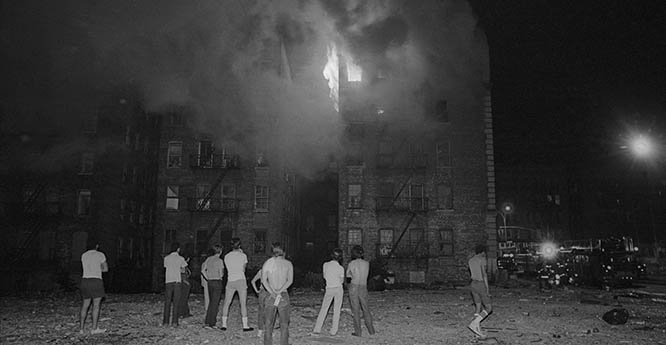
In the last few decades, inequality in the United States has been redefined by uneven exposure to climate disaster. Yet long before the surge in dangerous weather events, the private insurance market reinforced the vulnerability of poor Americans by exacerbating rather than mitigating risk. In Born in Flames: The Business of Arson and the Remaking of the American City, historian Bench Ansfield investigates the infamous arson wave that engulfed the Bronx in the late 1960s and burned for over a decade. Contrary to the popular myth that residents torched their own neighborhoods, Born in Flames explains how failed regulation and the government’s misplaced faith in the market all but guaranteed the Bronx would burn. “The arson wave came to an end only because those whose homes lay in its path mobilized and fought back,” Ansfield argues. Today, this historical legacy lives on in a sacrificial economy that secures private wealth and property while leaving the urban poor exposed to chance. As homeowners in the Hamptons demand an even greater share of public attention, the Bronx faces the hazards of a warming planet under conditions of financial predation and state neglect. ...
Subscribe now to read the full article
Online OnlyFor just $19.95 a year, get access to new issues and decades' worth of archives on our site.
|
Print + OnlineFor $35 a year, get new issues delivered to your door and access to our full online archives.
|