A New Vision for Public Lands
A New Vision for Public Lands
Policy debates around public lands point to larger unresolved questions about the nature and function of the public trust. What should we do with this national resource at a moment of major transition?
Americans learn about public lands in history class, but if you live east of the Mississippi, you probably haven’t thought about them much since. You might know about the Homestead Act, which encouraged westward expansion by allowing settlers to make claims on land and take ownership after five years of residence. You could possibly recall the Taylor Grazing Act or the Federal Lands Policy and Management Act, which together changed the government’s approach from disposal and privatization to holding and management. But unless you’ve recently gone on a Western road trip, you’re unlikely to have noticed that the federal government still owns more than a quarter of the land in this country and that the Bureau of Land Management (BLM) is the nation’s largest landlord, managing 10 percent of the land in the United States. You likely don’t know that drilling on public lands is responsible for about a quarter of U.S. carbon emissions.
Yet public lands have been all over the news lately. At the 2024 vice presidential debate, J.D. Vance said, “We have a lot of federal lands that aren’t being used for anything. . . . They could be places where we build a lot of housing.” This probably seemed like an esoteric digression to most viewers, but it was a dog whistle to Utah conservatives, such as Republican Senator Mike Lee, who have been trying for half a century to eliminate public lands through privatization and development. This agenda was included in an early version of the One Big Beautiful Bill Act, which would have opened up 250 million acres of public land for sale, with 2 to 3 million to be sold within five years. That provision was removed after bipartisan opposition, though the final version does expand timber sales and oil and gas leasing. Trump has also streamlined approvals, rolled back environmental protections, and defunded national monuments—all to speed up extraction and “boost economic growth” on public lands. Even during the Biden administration, public lands were a growing political issue. There was an early move to freeze oil and gas leases, as well as conflicts over lithium mining, speculation around renewables related to rising demand for EVs and batteries, and fights over grazing, conservation, and water use.
Public lands are leftovers: the deserts and grasslands that were too dry for farming or settlement in the nineteenth century and weren’t awe-inspiring enough to be designated national parks or forests. They were constituted in their current form in the 1940s, when the General Land Office and the U.S. Grazing Service were merged, creating the BLM, which still manages public lands under a “multiple use” mandate, as public resources for recreation, grazing, conservation, or extraction.
Their recent news appearances reflect public lands’ status as a fix for a variety of twenty-first-century problems. Arid, windswept valleys that were useless for settlement are now perfect for renewable energy. Desert habitat deemed “empty” by European settlers has been revalued by scientists. Public lands have become sites for the exercise of Indigenous sovereignty and new experiments in federal and tribal co-management. Housing developers see land encircling some of the fastest-growing cities in the United States as an opportunity for new construction. Though public lands have long been used as assets to subsidize development, the climate crisis, the extinction crisis, and the housing-affordability crisis have produced a round of speculation and proposals for a variety of conflicting uses unlike anything in the past seventy-five years.
These new, competing pressures on public lands underscore the need for a coherent progressive platform that articulates some principles for their use and management. Policy debates around public lands tend to be topical—where and how to build out energy, streamline permitting processes, develop housing, or extract water and other resources—but they point to larger unresolved questions about the nature and function of the public trust. What should we do with this national resource at a moment of major transition?
The Common Wealth
Public lands trace their origins to the “public domain” created by the federal government out of the Western territories following the Revolutionary War. These lands were bolstered by the Louisiana Purchase of 1803, the purchase and annexation of Texas in 1845, and the Mexican Cession of 1848. The original inhabitants were violently dispossessed and removed. As the sociologist Mary Shi has argued, following the high costs of their acquisition, public lands came to appear as freely available resources that the federal government could distribute for a variety of ends.
Both Democrats and Republicans have had essentially the same approach to public-lands management since the nineteenth century: using them to support high-profit, capital-intensive industries with the right hand, while pursuing conservation in narrowly defined locations with the left. In the nineteenth century, they were used to entice westward settlement. In 1862 the Homestead Act allowed any U.S. citizen to claim a 160-acre parcel provided they “improved” it while in residence for five years; a decade later the 1872 Mining Law allowed citizens to claim and mine land containing valuable mineral deposits without paying any royalties to the federal government.
Public lands also became central to the goal of encouraging large-scale private development, particularly in the realm of infrastructure. While the federal government has sometimes financed infrastructure directly, more often it has done so indirectly, by subsidizing private developers’ costs. The paradigmatic case was the railroads. They were deemed essential for opening Western markets and facilitating Western settlement, and received grants totaling 7 percent of U.S. land. Companies then sold the land they’d received for free and used the profits to support construction. This process produced a transcontinental railroad, though it also had the effect of producing routes that made more sense for capital than passengers—increasing social costs to maximize private profit.
Meanwhile, conservation was pursued in other, specifically demarcated places with particular aesthetic qualities and ecologies. Part of the historical undervaluation of public lands has been attributed to European “eyes trained on universal chlorophyll,” as the writer Wallace Stegner put it. Rather than dry desert basins, American conservation has historically prized lush forests and dramatic mountains, as are found in national parks—the first of which, Yellowstone, was created in 1872 on the heels of the railroad boom. As environmentalism grew during the twentieth century, mainstream movements continued to direct their attention to sublime landscapes and charismatic fauna taken to be intrinsically valuable, while public lands were sites of utilitarian military testing, nuclear waste disposal, grazing, extraction, and development. Even on BLM lands, wilderness designations were mainly reserved for “rocks and ice wilderness”—high, isolated mountaintops with few competing uses—while lower lands with economic value were managed under multiple use.
Cross-Party Throughlines
In this twenty-first-century moment of revalorization of arid lands, the old patterns are evident. Even with the ping-ponging from Obama to Trump to Biden to Trump, there have been more continuities than differences in approaches to public lands. In energy policy, both parties have streamlined environmental regulations, in pursuit of different extractive agendas, but with a common goal of “energy independence” that has de facto centered on public lands. Obama designated national monuments, but also massively expanded fracking and natural gas drilling. In his first term, Trump removed environmental protections and accelerated environmental reviews to promote coal, oil, and natural gas production.
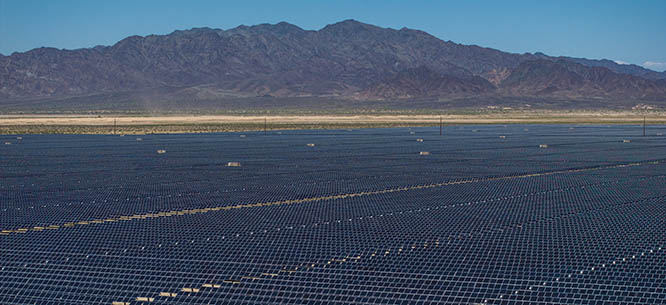
When Biden took office, his administration reversed Trump’s cuts to environmental protections and made other progressive moves on public lands, including expanding efforts to co-manage lands with tribal governments and putting a pause on oil and gas leasing. But its major focus was on renewable energy, and there, Biden’s green industrial policy followed a long-standing pattern of using public lands to lower the costs of private development, rather than pursuing any kind of more comprehensive reform. To encourage “utility-scale” renewable energy projects on public lands, the administration codified one of Trump’s main changes: providing cheap leases to developers and using strategic deregulation to expedite permitting and approvals. This produced a speculative green-energy rush in areas suitable for development, with planned transmission lines, lithium claims (still driven by the 1872 Mining Law), and filings for solar and wind projects peppering Western deserts. Some critics described the resulting projects as a “virtual privatization” of public lands that reduced multiple uses to one—energy—fenced in and managed by for-profit developers.
Biden’s path to renewables followed the railroads. He used a tried and tested paradigm for infrastructure development that made sense given the need for speed. But it also shunted development along the paths of least resistance: where large parcels of public lands made large-scale development fast and feasible, rather than prioritizing places that made the most sense from other perspectives, including environmental ones, such as brownfields or exhausted agricultural areas. This policy framework made it cheaper for developers to secure land, but it had higher costs elsewhere, including increased consumer prices for long-distance energy transmission and the loss of desert habitat. It oriented large, private owners toward pursuing renewables through speculative investments on undisturbed lands, as opposed to encouraging a mix of utility, community, and rooftop scale across different kinds of spaces.
Scientists now understand the conservation value of deserts—for biodiversity, carbon sequestration, and as evolutionary models for a hotter, drier future. However, with a few notable exceptions, Biden’s conservation efforts also treated desert basins as extractive land and pursued conservation in other places. The 30×30 Initiative, for example, which established a national goal to protect at least 30 percent of U.S. lands and waters by 2030, represented a broadened vision of conservation that emphasized local leadership, tribal sovereignty, and job creation. But it also went for low-hanging fruit, in drawing from the “rocks and ice” Wilderness Study Areas of the 1970s that had little value for wind, solar, lithium, or geothermal projects. As a result, the administration sidestepped the challenging questions of how and where to pursue new forms of energy development on public lands that also have clear conservation value.
Trump has flipped from encouraging renewables to providing life support for fossil fuels. He has cut subsidies and funding for Biden-era renewable projects and staff and funding at the BLM, halting many wind and solar projects that were in the pipeline and, in some cases, already under construction. Unlike Biden, under Trump there’s no left hand pursuing conservation while the right leads extraction; Trump has also gone right back to attempting to shrink national monuments and stripping away environmental protections. His latest proposed changes include reducing fees, encouraging prospecting, incentivizing geothermal leasing, and protecting mining claims.
Yet a fundamental similarity persists across the two administrations: public lands remain a key resource deployed by the state in support of private energy development. “Republicans spent four years railing against former President Joe Biden’s use of Washington’s money and regulatory heft to promote wind farms, solar panels and electric cars,” Zack Colman wrote at Politico. “Now President Donald Trump is wielding the same mighty federal arsenal on behalf of oil, natural gas, coal and nuclear power.” Colman is right—but this insight can be extended further back. Both parties have long used state subsidies and procedural reform to incentivize and secure the bubbles of private investment that American infrastructure development has relied on. And one of the most valuable resources they have on offer is public lands.
To see an opposite energetic and extractive agenda accomplished through the same techniques is uncanny. The stated goal of a new instruction memorandum for oil and gas leasing—to “increase the availability of onshore federal lands for leasing, reduce bureaucratic delays, and enhance public engagement”—could have been written by either administration. The steps Trump has taken to increase mineral production on public lands are not so different from Biden’s efforts around lithium. And in some cases, the ties are even more direct. In Nevada, a new transmission line called Greenlink West was approved under Biden, despite concerns about construction-related disturbances to Mojave Desert habitat. It was designed to carry primarily renewable energy, but under Trump critics now worry that it is more likely to power data centers and serve out-of-state consumers with electricity produced by fossil fuels. The Greenlink North transmission line, which is currently in the approvals process, represents an even greater threat. It is slated to run along Highway 50, “the loneliest road in America,” slicing the Great Basin Desert’s rare remaining greater sage-grouse habitat. Under Biden, construction in priority habitat areas was justified in the name of renewable energy; now, the Trump administration is seeking to eliminate some of these protected areas entirely.
Appeals to conservation are the primary legal route to stopping such developments. The 1970 National Environmental Policy Act (NEPA), which governs the environmental review process, evaluates impacts based on a case-by-case consideration of the “purpose and need” of each individual project, such as a single solar farm or transmission line. This means that BLM staff responsible for approvals evaluate the proposed line in terms of the need to move energy around, and impacts in terms of where the line will run, rather than larger likely path dependencies, such as how opening up a desert in this way produces a new energy corridor along which many large projects are likely to follow. Meanwhile, environmental groups that used the Endangered Species Act to stop poorly sited renewable energy projects during the Biden administration will now employ the same legal strategy under Trump to oppose fossil fuels. But Trump’s Interior Department is making cynical use of the same conservation laws, wielding them as “cudgels” to stop renewables. The administration might stop offshore wind projects only to open up the same waters for far more harmful offshore drilling.
These parallels underscore the insufficiencies of current policy and legal tools and how limited, in these terms, even the most ambitious Democratic renewables efforts were. Streamlining permitting processes sounds great when supporting renewable energy development—less so when confronting renewed oil and gas leasing. And environmental laws more than a half-century old simply are not adequate for adjudicating competing uses today; we face new forms of extraction and possess new scientific knowledge, and the political environment has vastly changed. More fundamentally, the federal government continues to rehash and reproduce an old approach to land management: privatize public assets and intensify extractive activities.
The limitations of this approach are particularly visible in the burgeoning discussion of building housing on public lands. Six months after the debate at which Vance entertained the idea, the New York Times ran an editorial and an article sympathetic to housing development on public lands in Nevada and Utah. Western cities are among the fastest growing in the United States, and yet they are landlocked: islands of private property surrounded by an ocean of federal land too dry for farming or recreation. The editorial echoed recent arguments presented in Ezra Klein and Derek Thompson’s Abundance and NIMBY/YIMBY housing debates, saying, “The United States has a housing crisis in large measure because our society has become better at saying no than saying yes. We’ve become so focused on the costs of building that we’ve lost sight of the damage that we are causing by not building.”
There’s ample evidence to suggest that such proposals are more likely to result in the construction of luxury second homes far from existing infrastructure than in a solution to the housing crisis. The move from a virtual to a literal privatization of public lands subsequently attempted in the One Big Beautiful Bill, which would have helped pay for Trump’s tax cuts by “disposing” of millions of acres—that is, selling them off to developers—revealed the housing proposal as a Trojan horse designed to transfer public lands to private hands. Perhaps surprisingly given their history of opposition to federal management of Western lands—from the Sagebrush Rebellion of the 1970s and ’80s to the Bundy family’s 2016 occupation of the Malheur National Wildlife Refuge—Republicans in Western states ended up killing it. Despite Republican support for extractive uses of public lands, and smaller land sales and swaps, they balked at the idea of dumping public lands “at scale,” even forming a bipartisan caucus to prevent future attempts.
The housing folly brings into relief the narrowness of public debate and policy imagination on these issues. Caught between conservation and development, many argue that there appears to only be one path to meeting urgent social needs. We’ll simply have to choose between housing or habitat, endangered flowers or lithium mines, recreation or gas leases, grazing or conservation. From such a perspective, those who object to needed developments are (at best) idealists unwilling to compromise, or (at worst) NIMBYs putting personal interests ahead of the public good. But as is the case in the broader affordable housing debates in the United States, the appearance of irreconcilable conflict is incomplete and misleading. Many on the left have chosen instead to find a third way. Various recent proposals for social housing are an actually existing progressive response that does not accept the trade-offs of market-led development as inevitable. The problem for public lands is there is no alternative progressive platform to which we can point.
A Progressive Vision for Public Lands
Public lands, like so many other social goods, are currently under attack. Advocates have to continue fighting the Trump administration’s ramp-up of oil and gas leasing, cuts to environmental protections, and layoffs of staff. But beyond defensive battles, we need a positive vision for twenty-first-century land use and management. Without one, debates even on the left have remained caught in the dichotomous structure that pits the extinction and climate crises—the need to save habitat and the need to develop carbon-free energy—against each other. Even the most progressive policy attempts have failed to tackle larger questions about where and how we develop, and how we value public lands.
Part of the problem is the long shadow of the racist, elitist, and masculinist history of mainstream American environmentalism. The left has an uneasy relationship to conservation, particularly in the United States, where it is often seen as environmentalism for the rich. A century and a half of conservation oriented toward the creation of wilderness playgrounds has left progressives with little sympathy for arguments for public lands on the basis of the intrinsic value of saving species or habitat. But this skepticism remains trapped in an old framework. The extinction crisis has made the issue of saving habitat more than a boutique concern for recreation or hunting grounds. Land Back and pipeline battles have raised the visibility of Indigenous-led, anti-capitalist environmental struggles on rural lands. We now know that deserts are not empty of human or ecological history, and we can see those characterizations as products of the settler-colonial encounter. We recognize the need to preserve large swaths of intact habitat not simply for the aesthetic pleasure of a view, but because it is essential for desert biodiversity.
A more expansive framework that combines insights from issue-specific progressive alternatives could help generate new possibilities in the present. For instance, the Climate and Community Institute has described a path to zero-emissions transportation that limits lithium mining by reducing car dependence and EV battery size and increasing lithium recycling, which would spare land in the process. The Environmental Protection Agency has identified opportunities to develop renewable energy on abandoned mine lands—rather than going to public lands first—bringing an alternative form of economic development to former mining communities. Arguments against sprawling, resource-intensive housing development dovetail with climate justice and sustainability advocates’ arguments for social housing close to jobs and services, as a way to reduce commute times and emissions. Each of these proposals refuses the idea that meeting twenty-first-century needs simply requires intensive and extensive new developments on public lands and identifies win-wins between economic and environmental goals.
But a progressive public lands framework needs more than individual policy proposals; it requires an articulation of larger principles and values. “Ecosystems are ultimately better thought of as infrastructures rather than commodities: as systems that support a range of other activities rather than as discrete goods or services to be exchanged directly,” Alyssa Battistoni recently wrote in this magazine. “What kind of work do ecosystems do, and for whom? What kinds of ecosystem public services do we need to make our planet a livable one for humans and nonhumans alike?” Public lands are a key site of these questions. They may play an important role in the climate, extinction, and housing crises, but they can’t be fixes for all things; they can’t serve competing purposes at the same time and in the same location.
Whatever its priorities, a progressive approach to public lands will also require more large-scale planning, rather than just deregulation, which leaves public lands vulnerable to regressive as well as progressive forms of development. As the examples above suggest, most alternatives to state-supported and market-led development require coordination across sites of extraction and production, mountaintop and desert basin, city and hinterland. During the New Deal, a National Resources Planning Board—the only national planning board in U.S. history—took such a capacious view of integrated social, economic, and ecological planning. In the wake of the Dust Bowl, amid truly massive changes in population distribution and the economy, the NRPB’s planning incorporated soil conservation and reforestation projects, housing and greenbelts, water and resources, minerals and energy. The board thought about where and how people should live given the economic and ecological realities of the time, about connections between places, and about larger patterns of resource use. As Berkeley political scientist Albert Lepawsky, an active participant in the New Deal, wrote in the 1970s, the NRPB “demonstrated a . . . precocious concern for and the planned treatment of natural resources, including such neglected economic externalities as environmental pollution . . . on an interstate, interregional, and nationwide scale.”
Planning can’t fix everything, of course. It creates problems of its own, and comes with the usual limitations of a capitalist state. Nor is the NRPB an exact template for the kind of thinking needed today. But it’s a good reminder that large-scale institutional reforms have historically accompanied large-scale land-use changes and infrastructural investments. In the absence of coordination across sites and issues, highly consequential land-use decisions get made with insufficient attention to the big picture. Rather than developing public lands through deregulation, we need decision-making structures adequate to the needs, principles, and scientific understandings of this moment.
Landscape-scale planning is one strategy for helping maintain ecosystem integrity and balance competing uses over a large territory. This principle is currently mostly absent from renewable energy development under NEPA, given its site-by-site consideration of environmental impacts. Recent efforts to cut red tape and streamline permitting have targeted the NEPA process, but what actually slows development is usually not NEPA itself but problems in the private sector: opaque and overloaded interconnection queues, finance and equipment problems among investor-owned utilities, and insufficient planning by mining companies. Simple deregulation doesn’t address any of these sources of delays.
One alternative model advocates point to is the 2016 Desert Renewable Energy Conservation Plan (DRECP), which successfully integrated energy and conservation planning across 22.5 million acres of California desert. Patrick Donnelly, Great Basin Director for the Center for Biological Diversity, a fierce advocate for public lands and one of the strongest national voices on these issues, describes the DRECP as “a hell of a good deal” for conservation. The DRECP secured over 6 million acres for conservation, “prescreened” sites to speed permitting and approvals and, according to Donnelly, has been met with zero litigation. By contrast, the BLM’s new Western Solar Plan, released in 2024, cast an energy-only eye over eleven Western states. In line with such precedents, Donnelly and other advocates, such as the Climate and Community Institute, have called for deregulation that is oriented toward transition (i.e., not just adding renewables to fossil fuels), that is reparative and planned, and that includes public renewables, community engagement, distributed energy, and updates to the 1872 Mining Law.
If we were to get federal land use planning now, what principles might govern it? Here’s a proposed mantra: decarbonize, decommodify, decolonize.
Decarbonize: Public lands will be part of the shift away from fossil fuels. There’s little question that at least some large-scale development is necessary, and that even with lithium recycling, power line upgrades, and so on, at least some public lands and waters will be sites of new renewable energy infrastructure.
Decommodify: At the same time, continuing to treat public lands as freely available resources to subsidize private development misunderstands them and displaces costs onto consumers and ecosystems. Seeing them instead as a public trust—whose value should be weighed against the costs of energy development elsewhere—changes the calculus of developing polluted mine lands, or exhausted agricultural land, and securing those sites through purchases or eminent domain.
Decolonize: Giving land back remains a worthy goal. But public lands have also been sites of recent progressive experiments in co-management and the restoration of Indigenous sovereignty. The most public instance was the establishment of the Bears Ears National Monument, where the U.S. federal government is managing land with a coalition of tribal governments as peer nations for the first time. Successes have also included the designation of new monuments and expanded definitions of science and approaches to management on public lands. Beyond the symbolic significance of such gestures, any new approaches to conservation and stewardship should come with a real sharing of power.
Urban social movements have not been focused on their relationship to these issues because public lands are far away and out of sight. It’s been too easy to think of public lands as a rural issue—or not think about them at all. Yet the majority of new pressures on public lands result from urban needs and consumption: for cheap and carbon-free energy, for affordable housing, for conservation and recreation. As one journalist summarized an environmental advocate’s comments, “Angelenos driving electric vehicles ought to think about how their choices affect Nevada.” This isn’t a guilt trip—it’s an invitation. To the extent that public lands can and should be considered a public trust, urban climate movements should see themselves as stakeholders in these issues, rather than ceding this territory—politically and literally.
Opinion on public land is one of those rare areas that bucks the urban-rural political divide. According to the president of Trout Unlimited, a nonprofit conservation organization that works mostly with hunters and anglers, it’s even “nonpartisan.” As the excision of the public lands portion of the One Big Beautiful Bill reflects, some Republican politicians may want disposal, but more Republican electeds and voters don’t. In the West, hunters, environmentalists, recreation enthusiasts, and Indigenous groups have all worked together in support of public lands. Like affordable housing, public lands are widely popular, appeal to a broad base, and are an opportunity for coalition building.
A progressive national constituency hasn’t yet cohered around public lands. But we will need one in whatever rebuilding is to follow Trump’s attacks on this public trust, and for the future to come.
Hillary Angelo is an associate professor of sociology at the University of California, Santa Cruz. She is currently writing a book on the American West’s 610 million acres of public lands.